
Choosing a supplement manufacturer isn’t only about finding the supplier who can manufacture your supplement at the cheapest price possible. Instead the ideal supplier needs to qualify on other matrices such as quality system, manufacturing capabilities, formulation support, ingredient sourcing, room to scale and dependable supply. Ireland is already one of the most lucrative manufacturing hubs because of the country’s strong regulatory reputation, EU market access and established supply chains. So the question arises in front of you is what factors to consider when you are choosing your supplement manufacturer in Ireland.
This guide walks through the factors worth evaluating before you sign a manufacturing agreement and make a well informed decision on the basis of facts instead of your gut feeling.
What Should You Look for in a Supplement Manufacturer in Ireland?
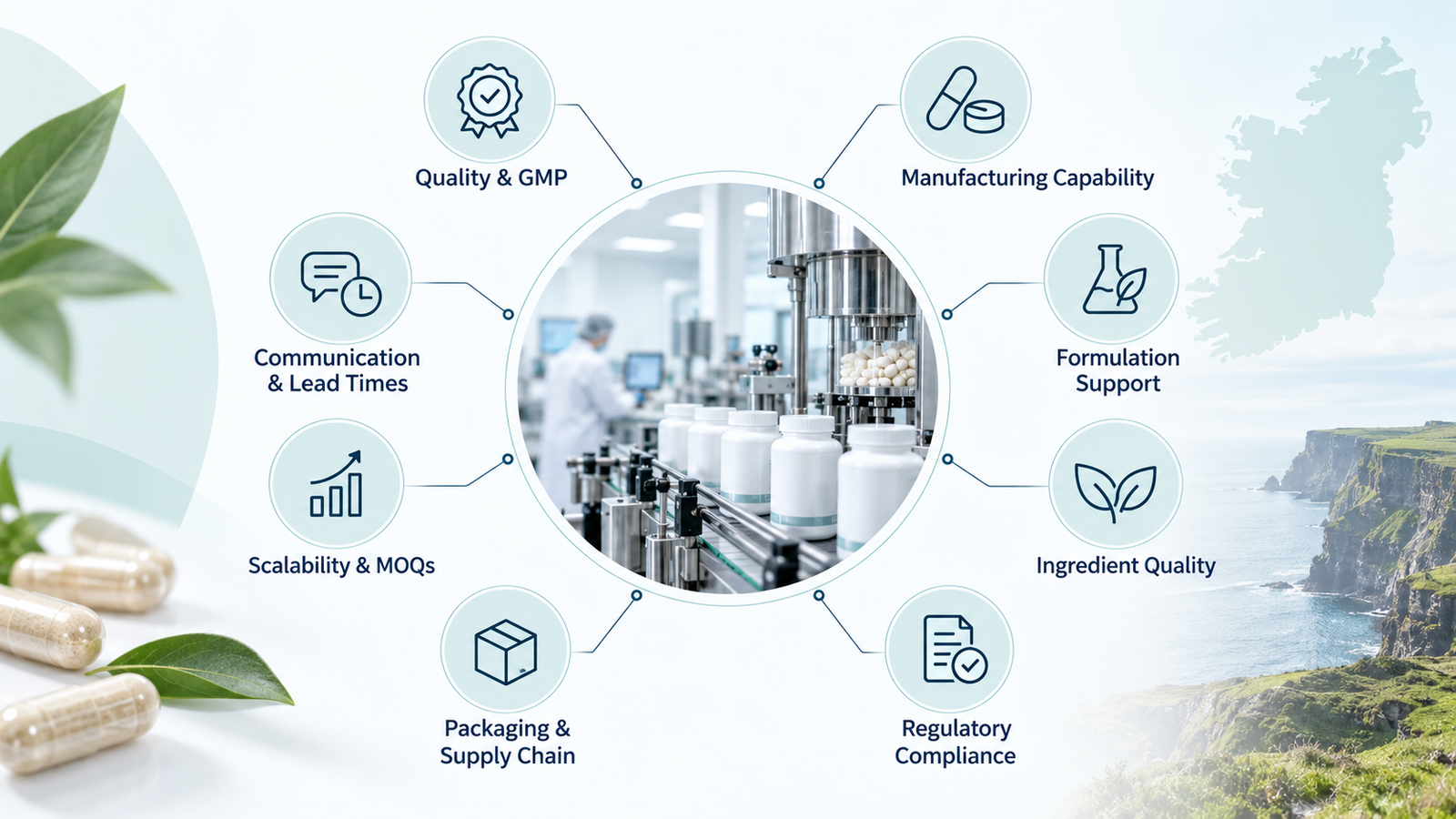
The key factors to evaluate are: quality certifications and manufacturing standards; product and dosage-form capabilities; formulation and development support; ingredient sourcing and testing; regulatory and compliance support; packaging and supply-chain capabilities; minimum order quantities and scalability; and communication, lead times and overall commercial fit. After a thorough evaluation of these factors you can identify a good supplement manufacturer with whom you can continue to do your business for long-term.
1. Check GMP Certification and Quality Standards
The first thing you should ask for and verify the authenticity of is Quality Certification. Good Manufacturing Practice (GMP) has already specified controlled processes, documentation and consistency that separate the production partners available in the market. Technically, it means every batch gets produced through a validated process, raw materials and finished products are traceable, and quality checks after every production are mandatory.
Certification should always be verified rather than assumed. Directly ask to see them, not just hear about them. Alongside GMP, food-safety systems such as HACCP and FSC 22000 (Food Safety System Certification) also specifies hazards are identified and controlled throughout production and not just at final inspection check.
It’s also worth noting that not every supplement manufacturer operates its own factory. Many work through approved manufacturing partners, which is a legitimate and common model provided those partner sites are properly certified. Bioreva Sciences, for example, states that its dietary supplement manufacturing facilities are GMP, HACCP and FSC 22000 certified. Whichever model a manufacturer uses, ask directly which site actually produces your product, and request evidence of its certification. This is one of the clearest ways to separate genuine supplement manufacturers in Ireland brands can trust from those simply reselling capacity.
2. Can the Manufacturer Produce Your Product Format?
Manufacturing capability needs to match your actual product specification, not just the manufacturer’s general claims of experience. Ask specifically whether they can produce your intended format (tablets, hard capsules, softgels, vegan capsules or powders) along with the filling and packaging format you need, such as blister packs, bottles or tubs.
It’s equally important to confirm they can handle your required production volume, not just the format itself. A manufacturer that produces beautiful capsules at small scale may struggle once you need larger, repeatable batch runs. Bioreva’s, for instance, cover tablets, hard, soft and vegan capsules and powders, with filling and packing across blister, bottle and tub formats which illustrates the kind of format flexibility worth asking about. This is how the conversation moves naturally from “can they make it?” to “can they deliver it in the format and volume my brand actually needs?”
3. Does the Manufacturer Support Formulation and Product Development?
Some brands arrive with a finished, tested formula ready to produce. Others need help developing one from scratch. A capable nutraceutical manufacturer in Ireland should be able to support and handle both scenarios.
Areas worth discussing include: whether you’re bringing an existing formulation or need a new one developed; ingredient selection and dosage considerations; how ingredients are sourced; stability testing to confirm shelf life; prototype and product development support; and whether white-label or ready-made formulations are available as a faster route to market. Bioreva presents formulation development, ingredient sourcing, stability testing and ready-made or white-label formulations as part of its offering the kind of end-to-end support that’s genuinely useful for brands still shaping their product. This is a valuable area to probe early, since a manufacturer’s formulation capability often reveals a lot about their overall expertise.
4. Regulatory and Compliance Support
Manufacturing a good product is only the first step of the process. Another important touch point is “compliance” that differentiate a good supplement manufacturer from the average one. Compliance touches almost every part of the process: product composition, labelling requirements, permitted nutrition and health claims, product notification, supporting documentation, batch release and testing, and support if you plan to sell into other markets.
In Ireland, the Food Safety Authority of Ireland (FSAI) is clear that the duty to notify falls on the manufacturer if a food supplement is produced in Ireland, or on the importer if it’s brought in from elsewhere and that composition, labelling and any nutrition or health claims must comply with applicable Irish and EU requirements. A strong contract supplement manufacturer can help reduce the risk of regulatory issues by building these considerations into the production process from the outset, rather than leaving compliance entirely to the brand. Bioreva’s regulatory service, for example, includes dietary supplement batch releases across Ireland and the EU, alongside regulatory support for wider markets.
5. How Are Ingredients Sourced and Quality Controlled?
Before signing a manufacturing agreement, it’s worth asking a few pointed questions: Where are ingredients sourced from? Are suppliers formally qualified and audited? What testing is carried out on incoming raw materials? How are materials identified and tracked through production? How is batch-to-batch consistency maintained? And is testing documentation available on request?
Don’t evaluate a manufacturer purely on the appearance of the finished product, instead understand how the raw materials entering the process are controlled in the first place. Traceability and documented testing at the ingredient stage are often the clearest early indicators of how seriously a manufacturer treats quality overall.
6. Can They Handle Packaging, Storage and Supply Chain Together?
A manufacturer can produce an excellent supplement and still create problems downstream if packaging and fulfilment are fragmented across multiple, poorly coordinated suppliers. It’s worth checking their capabilities across blister packaging, bottle or tub filling, sachets where relevant, secondary and tertiary packaging, storage, pick-and-pack services, logistics and final delivery.
Bioreva presents manufacturing, filling and packing, storage and logistics, and regulatory support as interconnected services rather than isolated activities which is a useful benchmark. It’s always beneficial in the long run if you consider a whole supply chain right from the start before making any decision.
7. What About MOQs, Lead Times and Scalability?
Always has detailed, clear discussion about the commercial aspects. Aspects such as minimum order quantities, typical batch sizes, production lead times, capacity for repeat orders, ability to scale as demand grows, flexibility to add new SKUs, and how communication and project management are handled day to day.
Rather than relying on generic marketing claims, ask prospective supplement manufacturers in Ireland some direct questions: What is your minimum batch size? How long does production typically take, from order to delivery? Can you support larger volumes if demand increases significantly? Getting clear, specific answers here rather than vague reassurances tells you a great deal about how the partnership will actually work in practice.
8. Are You Choosing a Manufacturer or a Complete Manufacturing Partner?
This is arguably the most important strategic question to ask before finalising any agreement. A production-only supplier will manufacture what you send them and little else. A complete manufacturing partner, by contrast, can coordinate the full journey: formulation, sourcing, manufacturing, testing, packaging, regulatory support, storage and delivery, working as a single connected process rather than a series of separate handoffs.
That sequence closely mirrors Bioreva’s own service proposition as an Ireland-based supplement manufacturer. For brands weighing up multiple quotes, it’s worth asking each supplier plainly where their responsibility starts and ends and how much of the surrounding process you’d need to manage yourself.
What’s a Simple Checklist for Choosing a Supplement Manufacturer?
Use this as a quick reference when comparing suppliers side by side.
| Criteria | Questions to Ask |
| Quality | Is the facility GMP certified? |
| Capability | Can it manufacture your dosage form? |
| Formulation | Can it support product development? |
| Ingredients | How are raw materials sourced and tested? |
| Compliance | Can it support Irish/EU requirements? |
| Packaging | Can manufacturing and packing be coordinated? |
| Scalability | Can production increase as your brand grows? |
| Supply chain | Can storage and logistics be managed? |
Final Thoughts
The best supplement manufacturer is not necessarily the cheapest one. The right manufacturing partner should give your brand confidence across quality, formulation, production, compliance and supply chain, not simply deliver finished units and leave the rest to you.
Bioreva Sciences is an Ireland-based supplement manufacturer offering manufacturing through GMP, HACCP and FSC 22000-certified partner facilities, alongside filling and packing, regulatory support and storage and logistics helping brands move from formulation through to finished, market-ready product under one coordinated process.
