
Contract supplement manufacturing is the business model where brands partner with a specialist third party manufacturer, for the production of its supplements and often the packaging as well under brand’s own name. Depending on the manufacturer and brand’s own requirement this relationship can expand into spanning formulation, ingredient sourcing, manufacturing, testing, packaging, regulatory support, storage and fulfilment.
Ireland has become a natural base for this model, offering established pharmaceutical and nutraceutical infrastructure and straightforward access to the Irish, EU and UK markets. So what should a brand actually understand before choosing a contract manufacturing partner? This article walks through how the model works.
What Is Contract Supplement Manufacturing?
Under supplement contract manufacturing, a brand doesn’t need its own factory, equipment or production licence. Instead, a specialist partner manufactures the product to agreed specifications covering ingredients, formulation, production, quality control and, often, finished packaging.
It’s worth distinguishing this from two related terms brands often hear used interchangeably. White label typically means an existing formula is supplied with a brand’s own labelling applied, with little or no adaptation. Private labels usually involve adapting an existing base formulation through dosage, ingredient or format changes to better suit a brand’s specific positioning. Contract manufacturing is broader still: it’s the overall production relationship in which a manufacturer builds and produces a product according to a brand’s defined requirements, which may include an adapted formula, a fully bespoke one, or something closer to off-the-shelf.
Why Do Brands Choose Contract Supplement Manufacturing in Ireland?
The appeal comes down to a handful of practical business advantages, without needing to overstate them.
Lower infrastructure requirements. Brands avoid the capital cost of their own manufacturing equipment, licensing and production facility.
Access to specialist expertise. A manufacturing partner brings established knowledge of formulation, ingredient sourcing, production processes and quality systems expertise that would otherwise take years to build in-house.
Easier product development. Moving from an initial concept to a manufactured product happens through one coordinated process rather than several disconnected suppliers.
Scalability. A capable manufacturer can support a brand from initial, smaller production runs through to significantly larger commercial batches as demand grows. Some Ireland-based partners, including Bioreva Sciences, can handle pilot runs from around 10,000 units and scale into multi-million-unit commercial batches for established products which matters considerably for brands planning supplement production Ireland-based, at growing volumes over time.
What Does a Contract Supplement Manufacturer Actually Handle?
This is really the core question most brands are trying to answer, so it’s worth breaking down stage by stage.
- Product brief: Understanding the intended product, target customer, dosage form and commercial objectives before anything else begins.
- Formulation: Developing a new formula or adapting an existing one to the brief.
- Ingredient sourcing: obtaining raw materials from approved, audited suppliers.
- Manufacturing: Producing tablets, capsules, powders or other agreed formats.
- Testing and quality control: Checking the finished product against defined specifications.
- Packaging: Filling, labelling and packing the finished product.
- Product release: Completing the relevant regulatory and release processes before the product can be sold.
- Storage and distribution: Holding finished stock and coordinating delivery to customers or distributors.
Bioreva’s own service description spans this same range formulation, ingredient sourcing, bulk manufacturing, stability testing, packing, product release, storage and delivery which reflects how comprehensive a genuine contract manufacturing relationship can be, rather than covering production alone.
Which Manufacturing Formats and Product Capabilities Should You Check?
A manufacturer stating they “manufacture supplements” isn’t specific enough. Brands should confirm actual dosage-form capability against their own product plans tablets, hard capsules, soft capsules, vegan or HPMC capsules, powders and, where applicable, sachets. Bioreva, for instance, currently lists round, caplet, breakline, chewable and film-coated formats under its tablets manufacturing capabilities, Hard gelatin, soft gelatin and vegan HPMC, filled with powders, granules, pellets or oils under its capsules segment and protein blends, vitamin, greens mixes, collagen and custom formulations under its powders manufacturing capabilities.
Another important aspect is packaging format options the manufacturer is providing and needs to be considered together with dosage form. Common pairings include capsules with bottles, tablets with blister packs, and powders with either tubs or sachets. Confirming both the dosage and packaging before signing the deal is a smart move before you invest your money and your contract manufacturer starts the production of your supplements at scale.
How Do Quality and GMP Standards Matter in Contract Manufacturing?
This is one of the most important areas to scrutinise, because it underpins the reliability of everything a manufacturer produces. Brands should investigate GMP compliance, HACCP, FSSC 22000, the wider quality management system in place, in-process checks, traceability, batch documentation and finished-product testing.
GMP compliance means production only follows validated, repeatable standardised processes for supplement manufacturing. HACCP (Hazard Analysis and Critical Control Points) is a preventative food safety management system which identifies and controls food safety hazards throughout production. FSSC 22000 provides a recognised framework for food-safety management more broadly.
One further point worth raising directly with any contract supplement manufacturer in Ireland you are evaluating: confirm exactly which facility and which certification apply to your specific product and production line, rather than assuming a general company-wide certification automatically covers every product and process.
How Does Formulation and Ingredient Sourcing Actually Work?
Depending on the product brief and your manufacturer capability you can either choose an existing formulation, adapt a base formula or even develop something more differentiated alongside ingredient selection, active ingredient combinations, dosage adjustments, format changes and stability testing to confirm shelf life.
Bioreva’s private label service, for instance, describes adaptations such as dosage-strength changes, format switches, ingredient swaps and proprietary blends, while its manufacturing offering separately covers formulation development, ingredient sourcing and stability testing. Together, this illustrates how much groundwork in nutraceutical contract manufacturing happens before production ever starts. Formulation decisions made early tend to shape everything that follows, from testing requirements to labelling.
Why Does Regulatory Support Matter in Contract Manufacturing?
Manufacturing and regulatory compliance can’t really be treated as separate processes, decisions made at the formulation and labelling stage directly affect whether a product can legally be sold. Food supplements marketed in Ireland for the first time must be notified to the Food Safety Authority of Ireland (FSAI). That notification responsibility generally falls on the manufacturer where the product is manufactured in Ireland, and on the importer where the product is brought in from elsewhere.
Beyond notification, supplement labelling carries specific mandatory requirements, nutrition and health claims must comply with applicable EU legislation, and ingredients themselves need to meet the requirements of the food-supplement framework rather than being assumed suitable by default. This is precisely why it’s valuable to work with a manufacturing partner that understands these requirements as standard practice rather than as an afterthought. Bioreva, for example, states that its regulatory team supports FSAI notification, EFSA health-claim review, ingredient compliance and QP batch release, with its regulatory service covering dietary supplement batch releases across Ireland and the EU.
Why Is Packaging Part of the Manufacturing Process, Not a Separate Step?
Packaging deserves consideration alongside manufacturing discussions, not as something bolted on afterwards. Relevant capabilities to check include bottle and tub filling, blister packing, sachet filling, label printing and application, carton packing, palletisation, and reworking or repacking where needed. Bioreva lists blister packing, bottle and tub filling, sachet filling, label printing and application, carton packing and palletisation as part of its packaging offering capabilities that support a genuinely integrated “one partner” model rather than handing packaging off to a separate supplier.
What Happens Between Manufacturing and Final Delivery?
Brands should ask any prospective manufacturer whether it can also provide aid post production in supply chain and logistics before making a final decision. This step includes:
- store finished stock,
- provide temperature-monitored storage,
- manage pick-and-pack operations,
- coordinate logistics and deliver directly to distributors or warehouses.
Bioreva offers HSE-approved finished and semi-finished storage, ambient temperature-monitored storage, pick-and-pack fulfilment and logistics support, again reflecting the kind of end-to-end supplement production in Ireland brands can plan around, from manufacturing through to the point of delivery.
What Should You Ask Before Choosing a Contract Supplement Manufacturer?
Use this as a practical checklist when comparing partners.
- Manufacturing: What dosage forms can you produce? What batch sizes can you accommodate? Where is production actually carried out?
- Quality: What certifications does the manufacturing site hold? What quality checks are performed during production? What batch documentation is supplied?
- Formulation: Can you adapt an existing formula? Do you provide formulation development? Can you source ingredients on our behalf?
- Regulatory: Who manages FSAI notification? Who reviews labelling and health claims? Who handles product release?
- Commercial: What is the minimum order quantity? What are the expected lead times? Can production scale as demand grows?
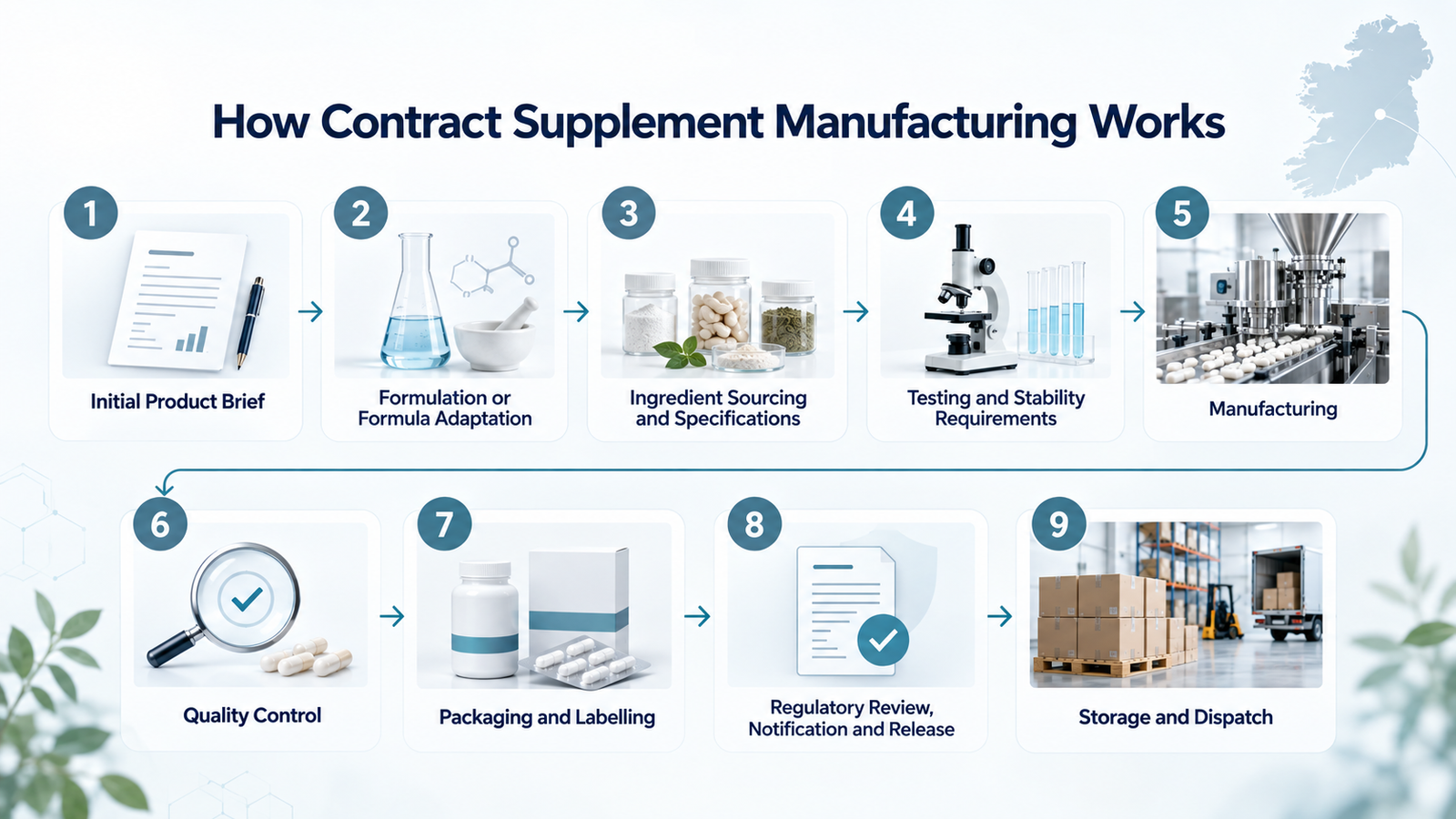
How Does Contract Supplement Manufacturing Work, from Brief to Finished Product?
- Initial product brief
- Formulation or formula adaptation
- Ingredient sourcing and specifications
- Testing and stability requirements
- Manufacturing
- Quality control
- Packaging and labelling
- Regulatory review, notification and release
- Storage and dispatch
This broadly mirrors Bioreva’s own process, which follows a similar four-stage journey: brief and quote, formulation and compliance, production and QC, then pack and dispatch.
Why Work With an Ireland-Based Contract Manufacturer?
Ireland offers some specific practical advantages worth noting. A local, direct relationship with an Irish-based manufacturing operation, easier day-to-day coordination around Irish regulatory requirements, straightforward positioning for EU market access, and manageable UK/EU supply routes from a centralised manufacturing and fulfilment base. Bioreva, for instance, is based in Longford and manufactures and distributes from Ireland into European and international markets.
It’s worth being realistic here rather than overselling the point: manufacturing in Ireland doesn’t automatically confer a regulatory advantage on every product. What it does offer is proximity, established infrastructure and a manufacturing base already positioned for EU and UK supply.
Final Thoughts
Contract manufacturing isn’t simply about outsourcing production done well, it brings together formulation, sourcing, manufacturing, quality, packaging, regulatory support, storage and distribution as one coordinated process. The right partner should be selected on capability, quality, regulatory understanding, scalability and how well its services integrate not on price alone.
Bioreva Sciences operates as a contract manufacturer for the nutraceutical and health supplement sectors from its Longford base, with private label formulation adaptation, filling and packing, regulatory support and storage and logistics managed under one integrated model.