
Blister Packaging Ireland: Understanding Materials, Formats and Packaging Considerations for Supplements
Explore blister packaging in Ireland: PVC/PVDC vs Alu-Alu, moisture protection, supplement formats and EU food contact rules for supplement brands.
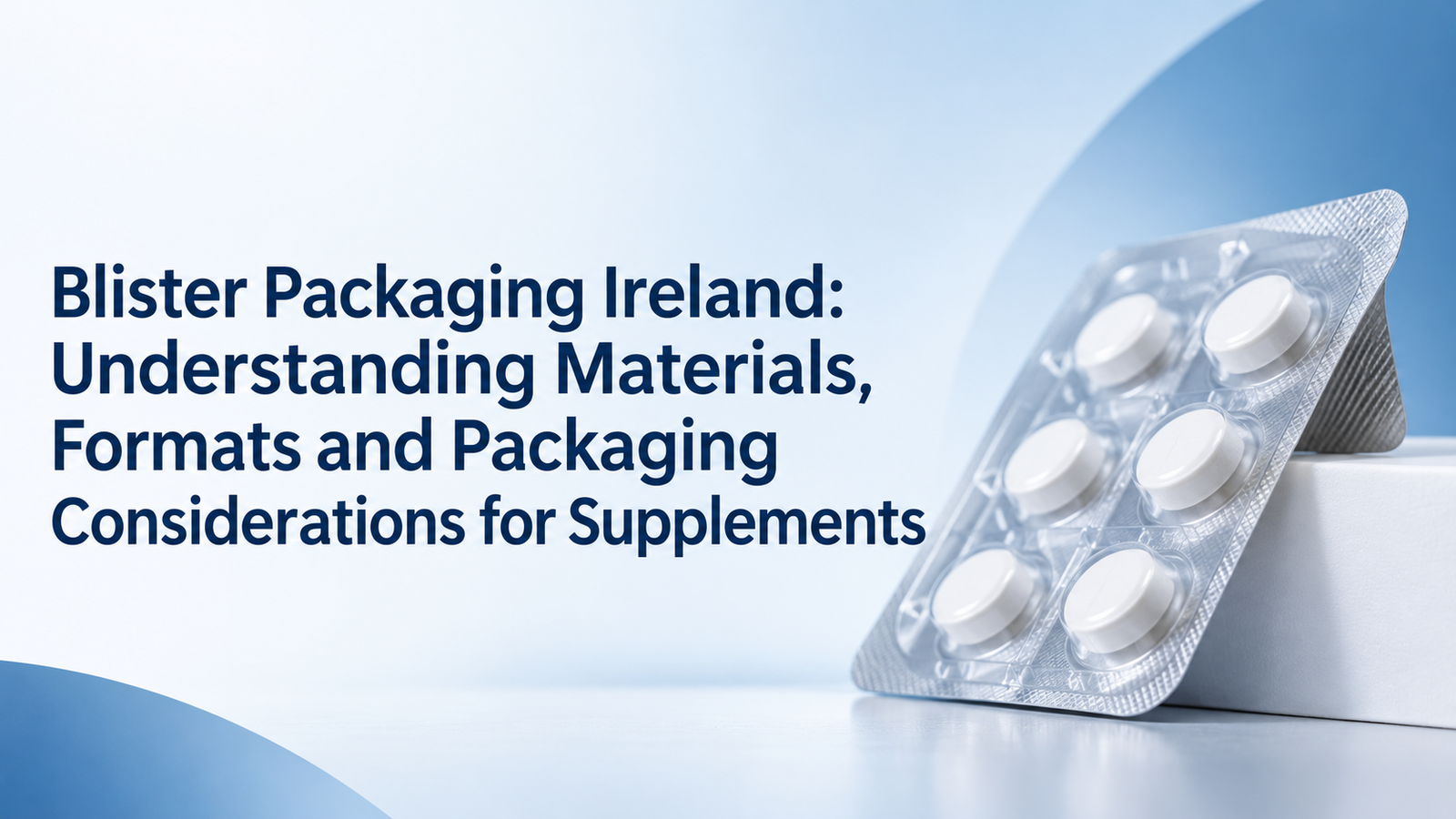
Choose the blister material to fit the formulation, not the other way round. It’s the principle worth holding onto if you’re comparing Blister Packaging Ireland options for a private-label range or your own nutraceutical line.
This guide covers how supplement blister packaging is built, where PVC/PVDC and Alu-Alu part company, what the research says about moisture, and the rules that apply in Ireland.
What is blister packaging and how does it work?
A blister pack gives every tablet or capsule its own sealed pocket. Two layers do the work.
The forming film is the base, shaped into a row of cavities with one dose in each. Over the top goes the lidding material, usually aluminium foil carrying a heat-seal coating, and heat plus pressure bonds the two together. A 2023 review in Cleaner Waste Systems splits the build into four parts rather than two, counting the heat-seal coating and printing ink separately.
Why bother? Every time a tub’s lid comes off, the whole contents get a breath of room air. With a blister, pushing out Tuesday’s tablet doesn’t touch Wednesday’s. That’s the main reason tablet blister packaging and capsule blister packaging turn up so often on daily-dose products.
Which blister packaging materials are used for supplements?
For supplements it usually comes down to two: PVC/PVDC, which is clear and heat-formed, and cold-form Alu-Alu, which is opaque aluminium. Neither wins outright; the formulation’s sensitivity to moisture, oxygen and light decides it.
PVC/PVDC blister packaging
PVC (polyvinyl chloride) softens under heat into the familiar see-through bubble, but on its own it lets more water vapour through than many products would like. So a coating of PVDC (polyvinylidene chloride) goes on, and that slows both moisture and oxygen considerably.
One catch: PVDC comes in different coat weights, and a light coat doesn’t perform like a heavy one even though both are sold as “PVC/PVDC”.
Cold-form aluminium (Alu-Alu) packaging
Here the forming film is a laminate, commonly oriented polyamide, aluminium foil and PVC, pressed into shape at room temperature. That aluminium core gives Alu-Alu its very high barrier against moisture, oxygen and light. The cost: nobody can see the product, and because foil won’t stretch as deep as warm plastic, the card ends up bigger for the same dose count.
How do the materials differ?
Factor | PVC/PVDC | Alu-Alu |
Construction | Polymer film with PVDC barrier | Aluminium-based laminate |
Moisture barrier | Depends on coat weight | Very high |
Light protection | Foil lid side only | Opaque on both sides |
Visibility | Transparent | Opaque |
Typical fit | Moderate barrier needs | Enhanced protection needs |
A stable mineral tablet may sit perfectly happily in PVC/PVDC. A strongly hygroscopic extract might be a different story. In most Blister Packaging Ireland projects the barrier question comes first, and the honest way to answer it is with stability data on the actual product.
How does blister packaging protect dietary supplements?
It slows moisture, oxygen and light on their way into each cavity, and it keeps unopened doses sealed while others are used. Slows, not stops.
Moisture protection and WVTR
Plenty of supplement ingredients are hygroscopic, soaking up water from the air that can soften a tablet or hurry along the breakdown of a sensitive active.
Packaging people measure this as water vapour transmission rate (WVTR): how much water vapour gets into a sealed pack over a set time, often given in milligrams per day per cavity. According to the PQRI Container Closure Working Group, the polymers that keep water out best have little affinity for it and tightly packed chains. And the film isn’t the only way in; heat-seal areas can also let moisture through, so a poor seal undoes a good film.
Back in 2001, Allinson, Dansereau and Sakr packed a moisture-sensitive tablet in several packaging types and reported in the International Journal of Pharmaceutics that its stability broadly matched what they’d predicted from the tablet’s moisture sensitivity and each pack’s barrier. The 2025 work by Pech et al. in Pharmaceutics pushed the idea on, connecting how much moisture a tablet takes up with how fast the drug degrades, so drug content could be forecast across shelf life for different blister materials. The authors see it as a route to less overpackaging.
Both papers tested pharmaceutical tablets, not supplements, so don’t borrow their figures. What does transfer is the method: the barrier a pack needs can be worked out from data, and that’s worth bringing to any Blister Packaging Ireland brief.
Protection against oxygen and light
Certain vitamins and omega-3 oils break down when oxygen or light gets at them. With PVC/PVDC, light comes straight through the clear cavity and only the foil lid shields the back. Alu-Alu blocks it front and back, which is why it’s often the pick for light-sensitive formulations.
Which blister formats suit tablets, caplets and capsules?
Tablets, caplets, hard-gel and soft-gel capsules can all go into blisters. What changes is the cavity. A round tablet needs a pocket matched to its diameter and thickness, with just enough clearance to drop in on the line and push out cleanly at home. Caplets are oblong, so length and orientation start to matter. Hard-gel capsules come in standard shell sizes, and the cavity has to be deep enough for the closed capsule without squeezing it. Soft-gels are the fussy ones: flexible, a little variable in shape and easily marked if they’re handled roughly.
Too snug and tablets crack or soft-gels dent; too roomy and they rattle around. Most supplement blister packaging work therefore starts with physical samples on the bench and tooling chosen to match.
What should you consider when choosing blister packaging?
Six questions settle most Blister Packaging Ireland decisions.
- Product sensitivity. How much protection from moisture, oxygen or light does the formulation really need?
- Dosage form and size. Will it sit properly in the cavity you have in mind?
- Material. Is PVC/PVDC enough, or is Alu-Alu justified?
- Volume. Manual blister packing works for small or trial runs; automated lines earn their keep as volumes climb.
- Tooling. Can an existing tool be used, or will you need custom blister packaging solutions for an odd shape or layout?
- Inspection. Are camera detection systems checking for visible faults, empty cavities included?
Decide on price alone and you risk a product that’s under-protected or a pack loaded with barrier it doesn’t need. A decent contract blister packing partner will walk you through that trade-off, and it’s a fair test to apply when comparing the blister packaging services Ireland has to offer.
What are the blister packaging requirements for supplement businesses in Ireland?
Supplements are food in the eyes of the law. That puts the blister under EU food contact rules and the product itself under supplement and labelling law: two separate sets of obligations, and meeting one doesn’t satisfy the other.
For the pack, Regulation (EC) No 1935/2004 lays down the safety principles for any material touching food, and Regulation (EC) No 2023/2006 says those materials have to be made under good manufacturing practice. PVC and other plastics also have their own rules in Regulation (EU) No 10/2011.
For the product, it’s Directive 2002/46/EC that governs composition, labelling and notification. Supplements may only be sold prepacked as a “Food Supplement”, and anything marketed in Ireland for the first time must be notified to the FSAI. Regulation (EU) No 1169/2011 on food information applies too. There’s rarely room on a blister card for all of that, so the mandatory details tend to live on the carton.
The Packaging and Packaging Waste Regulation (EU) 2025/40 has applied since 12 August 2026, with more requirements still to phase in, and multi-layer blisters are hard to recycle. This corner of Blister Packaging Ireland is the one most likely to shift in the next few years.
One more point: pharmaceutical packaging law doesn’t automatically apply to supplements. This is general information rather than legal advice, so check current requirements with the FSAI.
What should you look for in blister packaging services in Ireland?
Manual and automated packing, batch sizes that flex, existing and custom tooling, experience with your dosage form and inspection you can rely on.
At Bioreva Sciences, that’s the standard we work to. We pack tablets, caplets, hard-gel and soft-gel capsules by hand or on automated blister packing lines, in PVC/PVDC or cold-form Alu-Alu. Runs go from small to high-volume, we can use our existing tooling library or set up custom configurations, and camera detection helps us catch visible defects before packs move on. There’s more on how we handle Blister Packaging Ireland projects on our Filling & Packing page.
FAQs
What is blister packaging used for in dietary supplements?
Holding tablets, caplets and capsules in individually sealed compartments, so each dose stays protected until someone pushes it out. It also makes a missed dose easy to spot.
What is the difference between PVC/PVDC and Alu-Alu blister packaging?
Construction, mainly. PVC/PVDC is a clear plastic film, heat-formed and coated with PVDC to improve its moisture and oxygen barrier. Alu-Alu is an opaque aluminium laminate formed cold, with a very high barrier to moisture, oxygen and light, but you can’t see the product through it.
Is Alu-Alu blister packaging better for moisture-sensitive supplements?
Its moisture barrier is higher, so it’s often considered for strongly moisture-sensitive products. Whether that makes it better depends on the formulation. If stability testing shows PVC/PVDC copes, Alu-Alu may only add cost and a bigger card.
Can tablets and soft-gel capsules use the same blister packaging format?
The same materials, yes. The same tooling, rarely, because cavity size, shape and depth have to match each product and soft-gels need a gentler touch than compressed tablets.
What should supplement manufacturers consider when selecting blister packaging in Ireland?
Sensitivity to moisture, oxygen and light comes first, followed by dosage form, volume and tooling. After that, confirm the materials meet EU food contact rules and that your packaging partner can handle your format and batch sizes.
Is custom tooling available for supplement blister packaging?
Yes. A tool can come from existing configurations or be built around one particular tablet or capsule, taking its dimensions, cavity depth, card layout and production needs into account.
How do you choose the right blister pack for your supplement?
Work outwards from the product. Its sensitivity to moisture, oxygen and light tells you the barrier, its shape tells you the cavity, and your volumes tell you how it should be packed. Layer the EU food contact and Irish supplement rules on top and you’ll end up with a pack chosen on evidence rather than picked from a catalogue.

Providing global supply chain, connectivity, storage, packing and transport solutions in the healthcare industries. We are globally licenced and approved.
Our Capabilities
Contact Details
Unit A4, Gem Park, Athlone Road, Longford, Republic of Ireland Eircode: N39 T8Y7
- © Copyright 2026 by biorevasciences.com