

Packaging of a pharmaceutical and nutraceutical products does more than their protection from external damage as it has a direct impact on product’s shelf life and stability, dosage presentation, consumer usability, regulatory compliance, brand presentation and manufacturing efficiency. So how do you as a brand compare pharmaceutical packaging companies in Ireland before choosing an ideal partner for packaging of your product? You shouldn’t directly go for a partner who is quoting the cheapest price. You also need to evaluate other parameters such as packaging format, equipment, regulatory expertise, etc before making a final decision.
What Does a Pharmaceutical and Supplement Packaging Company Do?
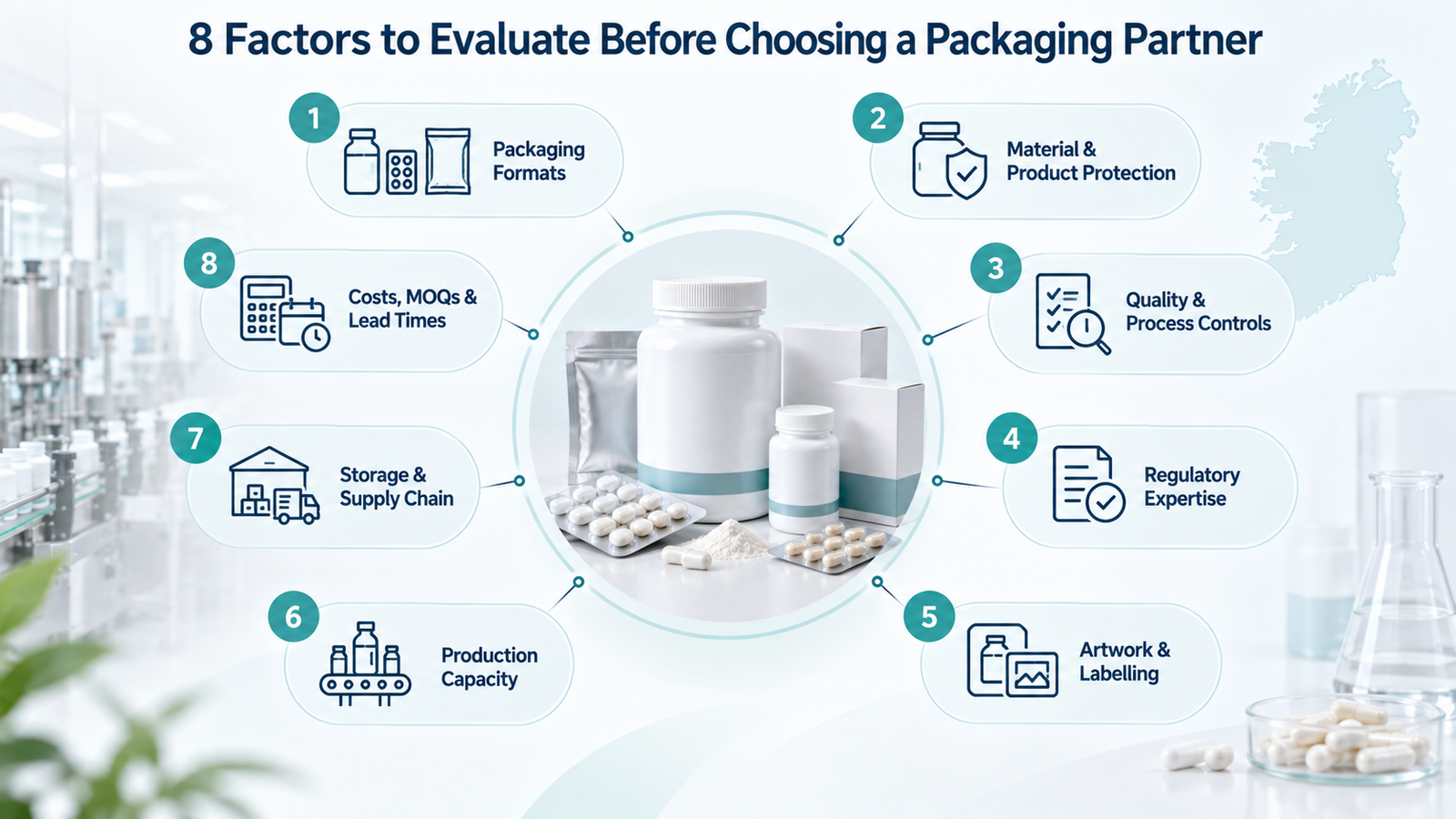
A specialist packaging company handles product filing, its primary, secondary and tertiary packaging, its labelling, its inspection and finished product handling. The three kinds of packaging can be defined as when the product is in direct contact with the packaging material like a blister or sachet it it is called primary packaging, the outer carton box that holds the primary pack is known as secondary packaging and the outer case or pallet configuration used for storage and transport is the tertiary packaging. You should have a clear understanding of the capability while you are evaluating your option for a pharmaceutical packaging supplier in Ireland for your brand.
Why Should You Start With the Product, Not the Packaging Format?
The right packaging depends entirely on the product. The packaging of your product directly depends on the properties of your product such as:
- Its format whether it is in tablet, capsule, powder or liquid form;
- How sensitive it is to moisture light or oxygen;
- dose size;
- shelf-life requirements;
- storage conditions;
- target market;
- how the end user will actually interact with the pack.
A packaging format that is ideal for one kind of supplement or pharmaceutical product might be entirely unsuitable for another. A moisture-sensitive powder has very different requirements to a light-stable tablet, for instance. Starting with the product’s own characteristics, rather than defaulting to whatever packaging format is easiest to source, tends to produce a far better outcome further down the line.
How Do You Evaluate the Packaging Formats a Supplier Can Support?
This is where most of the practical decision-making happens, so it’s worth going through each common format in turn.
Blister packaging suits individual dose protection and a compact format, and is commonly used for tablets and capsules where each dose needs to be separated into its own cavity. Bioreva Sciences, for example, lists blister packing as part of its filling and packing capabilities.
Bottle packaging suits multi-dose products, with flexibility around fill quantities and common material choices such as HDPE or PET. Bioreva similarly confirms bottle and tub filling as part of its offering.
Sachet and pouch packaging tend to suit powders, single-serving formats and other flexible-packaging applications, particularly where portion control or on-the-go use matters. These are worth evaluating on their own merits for suitable products though it’s always worth confirming directly with any prospective supplier exactly which formats, materials and equipment they can support for your specific product, rather than assuming every packaging company offers every format to the same standard.
How Should You Check Quality Standards and Packaging Controls?
Quality controls at the packaging stage matter just as much as those earlier in production. Worth evaluating: GMP or equivalent quality systems where applicable, food-safety systems for supplements, packaging-line controls, in-process checks, traceability, batch documentation, inspection procedures and error-detection systems.
As a brand you should have a clear cut knowledge of which controls apply to your specific product and production line, rather than assuming a simple general certification to cover every process your potential supplier runs. For example, Bioreva’s Longford facility is GMP, HACCP and FSSC 22000 certified which covers their manufacturing and packaging process and provides you a useful reference point for the kind of quality framework you should look for in your packaging partner.
What Should You Consider About Packaging Materials and Product Protection?
Material selection should directly depend on the product and its specific regulatory requirements. You shouldn’t ever go for the cheapest option available or material which is most readily available. Common examples include,
- PVC/PVDC blister materials,
- cold-form Alu-Alu for higher-barrier protection,
- HDPE or PET bottles.
There is no single product which is universally better for any kind of pharmaceutical product or supplement. It is more useful to ask whether the material provides enough protection for your specific product, its compatibility with the formulation, doesn’t hamper your product’s shelf life and it is suitable for your intended market. The right material for a moisture-sensitive supplement may be entirely wrong for a light-sensitive one, even within the same general packaging format.
How Should Regulatory Compliance Factor Into the Packaging Decision?
This is one of the most important distinctions in the entire selection process, because food supplements and medicinal products sit under genuinely different regulatory frameworks. Treating them as interchangeable is a mistake worth avoiding entirely.
For food supplements in Ireland, relevant considerations include FSAI notification requirements, supplement-specific labelling (recommended daily portion, dosage warnings, the “not a substitute for a varied diet” statement, and similar mandatory statements), general food-labelling requirements, and compliance with nutrition and health-claims rules under Regulation (EC) No. 1924/2006.
For medicinal products, a different framework applies entirely. The Health Products Regulatory Authority (HPRA) sets requirements for authorised medicines in Ireland, and labels and package leaflets form part of the authorised product information approved as part of that process, a fundamentally different regulatory pathway to the food-supplement framework. This distinction matters when choosing a partner: a supplier with strong food-supplement packaging experience won’t necessarily have the same depth of experience with HPRA-regulated packaging and leaflet requirements, and vice versa. Choose a packaging company with genuine, demonstrable experience in your specific product category and regulatory pathway, not simply one that offers the packaging format you need.
Why Look for Artwork, Labelling and Reworking Support?
Packaging needs rarely stay static once a product launches. Artwork changes, regulatory updates, label replacement, carton or patient information leaflet changes, reconfiguration, repacking and product inspection all tend to come up over a product’s lifecycle, often sooner than brands expect.
A packaging partner that can support these changes as they arise rather than treating the initial packaging run as a one-off, finished job tends to be considerably more valuable over time than one focused purely on the first production batch.
How Should You Assess Production Capacity and Batch Flexibility?
Supplier capacity should match your actual stage of growth, not an assumed future one. Worth discussing directly: whether the supplier can handle small production runs as well as medium and high volumes, whether processes are manual or automated, and what existing tooling is available versus what would need to be custom-built for your product.
A supplier well suited to a small initial launch batch may need different equipment or lead times to support a much larger run later it’s worth choosing a partner whose capability realistically supports both where your brand is now and where it’s likely to be in a year or two, rather than optimising purely for the immediate order.
Why Consider Packaging and Supply Chain as One Process?
A packaging supplier has more value when along with packaging it provides other services as well like manufacturing, storage, fulfilment and distribution and not just fulfill only one step of the supply chain. You should also discuss whether your supplier provides you temperature monitored storage for your finished product and can help with delivery to distributors or warehouses.
Bioreva, for example, positions filling and packing alongside manufacturing, storage and logistics as part of one connected supply chain, an approach worth looking for regardless of which specific supplier you choose, since coordinating these functions separately tends to introduce delays at the handoff points between suppliers.
How Should You Compare Costs, MOQs and Lead Times?
Reducing the decision to price per pack alone misses most of the real cost picture. Worth factoring in: setup and tooling costs, packaging materials, filling, artwork, minimum order quantities, storage, repacking or rework, testing and inspection, logistics and overall lead times.
Practical questions worth asking any prospective supplier: What’s actually included in the quoted price? Are there additional tooling costs on top? What’s the minimum batch size? And how is repeat production typically scheduled once the first run is complete? Clear answers here matter far more than a single headline per-unit figure.
What Questions Should You Ask Before Choosing a Packaging Partner?
Use this as a practical checklist when comparing suppliers side by side: What packaging formats and materials can you support? What quality certifications does your facility hold? What in-process checks and batch documentation do you provide? Can you support both my current volumes and future growth? Do you offer artwork, labelling and rework support alongside initial packaging? And can you coordinate storage and logistics as part of the same service, or would that need managing separately?
Supplement Packaging vs Pharmaceutical Packaging: What’s the Difference?
Packaging formats themselves can overlap considerably. Bottles, blisters and cartons appear across both categories. What differs is the regulatory framework governing them. Food supplements follow the applicable food-supplement framework, covering FSAI notification, supplement labelling and nutrition/health-claims compliance. Medicinal products, by contrast, are subject to medicinal-product authorisation and the relevant HPRA requirements, including approved label and package-leaflet content as part of the authorised product information.
The practical takeaway: choose a packaging company based on genuine experience with your specific product category and applicable regulatory requirements not simply because it offers the packaging format you happen to need.
Final Thoughts
Selecting a packaging partner should come down to product protection, quality, regulatory understanding, format capability, flexibility and supply-chain support, not packaging price alone. Get those fundamentals right, and the packaging itself becomes one less thing to worry about as the brand grows.
Bioreva Sciences combines filling and packing with manufacturing, regulatory support and storage and logistics as one integrated service for the supplement and dietary-supplement sector. Speak to Bioreva Sciences about your supplement or healthcare packaging requirements.