
Launching a supplement range no longer means developing and manufacturing every product from scratch. A private label supplement manufacturer allows businesses from startups to pharmacies and existing wellness brands to enter the market using established formulations, proven manufacturing processes and ready-made supply chains. Private labelling doesn’t simply mean choosing a product and adding a logo. Getting a good product-market fit means working through product selection, formulation, manufacturing, testing, packaging, regulatory compliance and FSAI notification before anything reaches a shelf.
So what does it actually take to start your own private label supplement brand in Ireland? This guide walks through each stage of that journey.
What Is a Private Label Supplement Brand?
A private label supplement is manufactured by a third party and sold under another company’s brand name. It is generally customised to some degree to suit a specific positioning and provide a slightly differentiated product to the brand. The manufacturer handles production while the brand controls naming, packaging and marketing. This differs from fully custom formulation, where a product is built from the ground up around unique ingredients or dosages. Most private label supplement manufacturer relationships sit somewhere between the two offering a faster route to market than bespoke development, without being a completely off-the-shelf product.
Which Supplements Should You Actually Sell?
There are certain things that should be clear in your mind about the product before you approach any potential manufacturer:
- your target customer,
- the health or wellness category you’re entering,
- your preferred dosage form (tablets, capsules, powders),
- how the product will be positioned,
- how many SKUs you want to launch with,
- your target price point,
- the order volumes you realistically expect.
Popular starting categories include vitamins and minerals, sports nutrition, men’s and women’s wellness, general wellbeing, beauty supplements, and herbal or botanical products. Anyone considering launching a private label supplement brand in Ireland should note that vitamins remain one of the most accessible entry points, given the range of established formulations already available. Whatever the category, resist the urge to launch with too many SKUs at once. A focused range of two or three products is far easier to manage, test and market than ten.
How Do You Choose the Right Private Label Supplement Manufacturer?
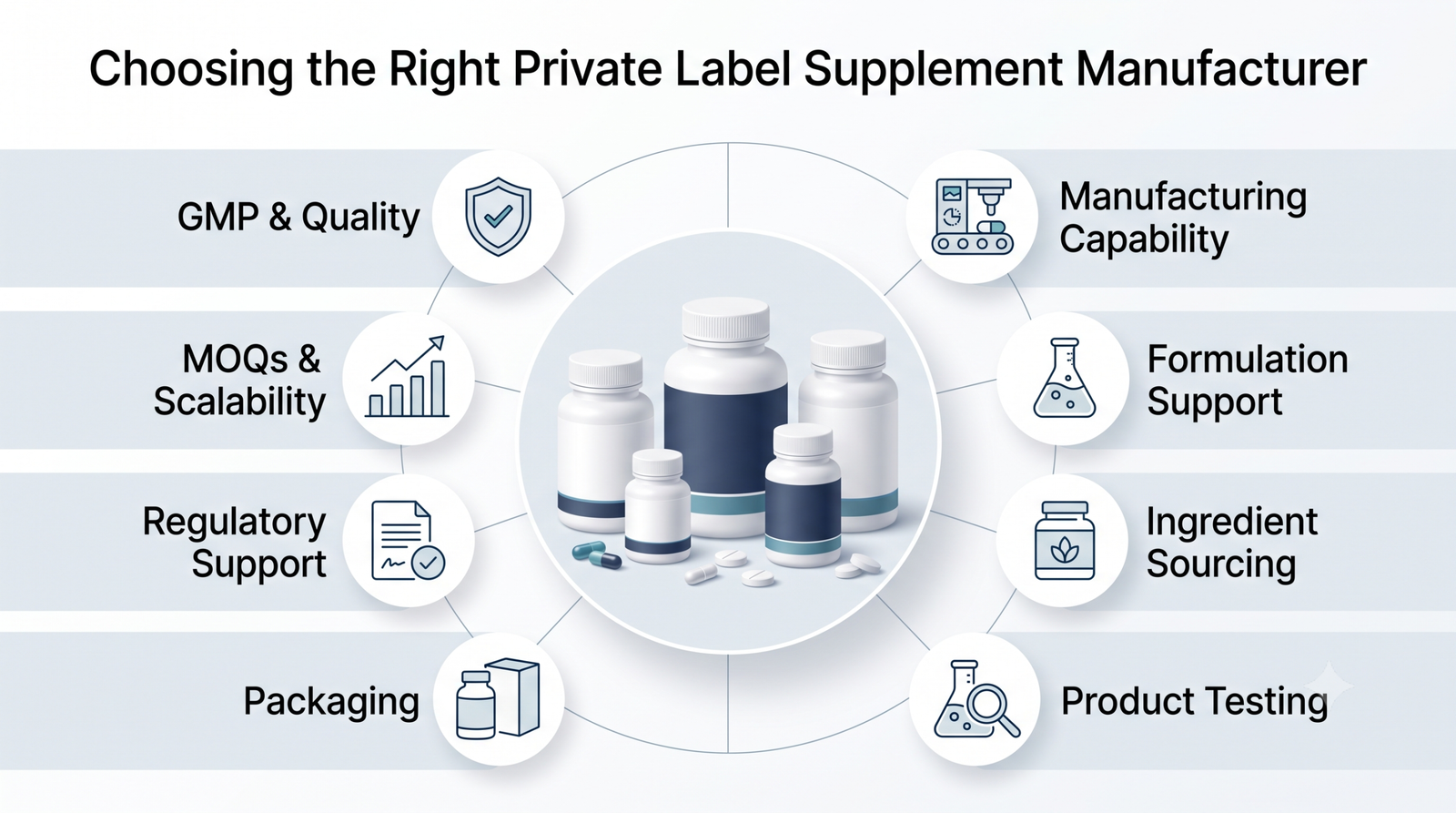
This decision shapes almost everything that follows, so it deserves proper scrutiny. Look at GMP and food-safety credentials, manufacturing capabilities, formulation support, ingredient sourcing, product testing, packaging capabilities, regulatory support, minimum order quantities, scalability and lead times.
Crucially, verify who actually manufactures your product rather than taking marketing copy at face value. Many private label suppliers work through approved manufacturing partners rather than owning a factory outright which is a perfectly normal business model, provided those partner sites hold genuine certification. Bioreva Sciences, for example, works with approved manufacturing partners that are GMP, HACCP and FSC 22000 certified, with production available across tablets, hard, soft and vegan capsules, and powders. A good private label supplement manufacturer should be able to answer these questions directly and provide evidence, not just reassurance.
Ready-Made Formulation or Custom Formulation: Which Is Right for You?
Ready-made, white-label formulations are for the businesses that want to enter the market quickly using an already-developed, tested product. But custom, private-label formulations are for the brands looking for product differentiation, a specific ingredient combination, a particular dosage, or a positioning that doesn’t already present in the market and is unique for the brand.
Bioreva presents both routes: ready and white-label formulations for a faster launch, alongside formulation development support, ingredient sourcing and supply-chain services for brands that want something more bespoke. The key point is that private label doesn’t automatically mean an identical, unmodified product; there’s always room to adjust dosage, ingredients or format even within a broadly “off-the-shelf” formulation.
How Are Ingredients, Testing and Product Quality Checked?
This is where product quality is actually built, long before packaging ever comes into the picture. Ask about ingredient specifications, how suppliers are controlled and audited, what product testing is carried out, how batches are traced, stability considerations, finished-product specifications and what documentation is available to support all of it.
A supplement brand’s quality reputation depends upon the quality of raw materials, the testing regime the supplement underwent and not on how attractive the packaging looks on a shelf. If a manufacturer can’t clearly explain their testing and documentation process, that’s worth treating as a warning sign.
What Are the FSAI Supplement Requirements Before Launch?
Anyone entering the Irish market needs to understand the regulatory framework before production even begins, not after. The Food Safety Authority of Ireland (FSAI) requires that food supplements marketed in Ireland for the first time be notified before sale. For products manufactured in Ireland, the duty falls on the manufacturer; for imported products, it falls on the importer. The FSAI advises businesses to check whether a product has already been notified by a supplier and, where it has, to keep a record of the notification number rather than duplicating the submission.
Ingredient composition also matters here: substances used in food supplements need to be suitable for that purpose, and certain medicinal ingredients or unauthorised novel foods aren’t permitted. Any nutrition or health claims made about the product must comply with the applicable EU rules under Regulation (EC) No. 1924/2006, rather than allowing free rein on wellness or therapeutic claims. Building FSAI supplement requirements into planning from day one and not retrofitting compliance after manufacturing, saves considerable time and cost down the line.
What Do Supplement Labelling Ireland Rules Actually Require?
Packaging deserves attention early, well before manufacturing is finalised, because labelling errors are expensive to fix once stock exists. Supplement-specific requirements include identifying the product clearly as a food supplement; stating the categories or nature of the nutrients or substances involved; the recommended daily portion; a warning not to exceed that dose; a statement that the product isn’t a substitute for a varied diet; a keep-out-of-reach-of-young-children warning; the quantities of relevant nutrients or substances; and, for vitamins and minerals, the percentage of the reference intake values.
On top of these supplement-specific rules, general food labelling requirements still apply which includes ingredient lists, allergen information, net quantity, durability or use-by dates, storage conditions, the responsible food business operator’s details, and standard nutrition information. All mandatory information also needs to be clearly legible on the pack. Getting supplement labelling requirements right the first time avoids a costly reprint cycle.
How Do You Develop Your Brand, Packaging and Artwork?
Brand name, visual identity, logo, packaging format, label artwork and product naming all need to come together but never in isolation from regulatory review. A striking design that omits a mandatory warning statement, or makes an unsupported health claim, will need reworking regardless of how good it looks. Bioreva supports this stage with brand identity, pack artwork, logo design and marketing collateral, developed alongside rather than separately from the compliance requirements covered in the previous step.
How Do You Plan Manufacturing, Packing and Fulfilment?
Once formulation, ingredients and artwork are settled, the physical production sequence follows: manufacturing, filling, packing, product release, storage and fulfilment. Bioreva’s packing capabilities cover bottle and tub filling, blistering, primary, secondary and tertiary packing, and reworking or repacking where needed, with storage and logistics support including temperature-monitored storage and ongoing fulfilment. Plan the entire supply chain as one connected process rather than treating manufacturing as a single, standalone order. The gaps between manufacturing, packing and delivery are where most launch delays actually happen.
What Should You Budget, and How Long Will Launch Take?
The different kind of costing that you should consider while deciding your budget are as follow:
- product development cost,
- Manufacturing cost ,
- Packaging & artwork cost
- Testing cost,
- regulatory work cost,
- Storage & logistics cost,
- initial inventory and marketing cost.
Before committing, ask prospective manufacturers: What is the minimum order quantity? Because for new businesses, they directly affect upfront cash flow and warehousing needs.
Also make sure to ask questions such as What are the expected production lead times? Can future batches be scaled up as demand grows? Are packaging and artwork costs quoted separately from manufacturing? Clear answers here make budgeting far more realistic than working from a single headline production quote.
How Does a Private Label Supplement Launch Work from Start to Finish?
- Select your product category
- Choose your formulation (ready-made or custom)
- Select a manufacturing partner
- Confirm ingredients and specifications
- Complete testing and compliance checks
- Approve packaging and artwork
- Manufacture and pack
- Complete notification and product-release requirements
- Store and distribute
- Launch your supplement brand
Final Thoughts
Launching a supplement brand in Ireland involves considerably more than putting a brand name on an existing product. The right partner helps coordinate formulation, sourcing, manufacturing, testing, packaging, regulatory support, storage and distribution as one connected process, rather than leaving a business to manage each stage separately.
Bioreva Sciences supports this full journey, from formulation development and ready or white-label formulations through approved GMP manufacturing partners, filling and packing, regulatory support and storage and logistics helping brands move from concept to shelf-ready product under one coordinated process.