
Launching a supplement brand doesn’t necessarily mean developing a completely new formulation or running your own manufacturing facility. White label supplements allow you to choose an already developed formulation, apply your own branding and packaging and bring your own finished product to market and all you need to do is select an ideal manufacturing partner to help you out with production of the formulation.
The basic journey looks like this: choose products, select a manufacturer, confirm the formulation, approve packaging, complete compliance checks, manufacture, pack, then launch. Choosing the right supplier still matters enormously here quality, formulation specifications, testing, packaging and regulatory compliance all shape the finished product, even when the formula itself already exists.
What Are White Label Supplements?
White label supplements are generally pre-formulated products that can be marketed under another company’s brand name, with branding and packaging created specifically for that customer. In practice, this usually means: an existing formulation, produced by the manufacturer, given brand-specific packaging, offering a faster route to market than fully custom development, and often selected from an established product portfolio.
Why Choose White Labelling for Your Supplement Brand?
A handful of practical, commercial reasons tend to drive this decision. Faster product development, since an established formulation removes much of the need to start development from zero. Lower development complexity, freeing the brand to focus more heavily on positioning, packaging and go-to-market strategy rather than formulation science. Access to established formulations, given that a manufacturer may already hold a portfolio of tested products across different categories. And easier portfolio expansion, since additional products can potentially be added later without building every new formulation from scratch.
Bioreva Sciences, for example, currently highlights white-label formulations alongside its formulation-development capabilities giving brands the option to start from an existing product or move toward something more customised as the business grows.
How Should You Define Your Supplement Brand and Target Customer?
Before selecting a single product, a brand needs a clear commercial direction. The goal is to fit the product to genuine brand positioning and customer demand, rather than choosing something simply because a supplier happens to offer it.
You already should have detailed information about who the product is actually for, which health or wellness category it addresses, brand positioning, price point, product format, the number of initial SKUs, and target sales channels. Popular starting categories for anyone looking to start a supplement brand in Ireland include vitamins and minerals, sports nutrition, men’s wellness, women’s wellness, general wellbeing and beauty supplements. A clear answer to “who is this actually for?” at this stage makes every later decision formulation, packaging, even manufacturer selection, considerably easier.
How Do You Choose the Right White Label Supplement Manufacturer in Ireland?
This is the main commercial decision in the whole process, so it’s worth being thorough. Brands should verify who actually manufactures the product rather than relying solely on marketing claims.
- Check quality standards: recognised manufacturing and food-safety systems, not just a general assurance of “high quality.”
- Check the product range: whether the supplier can genuinely offer the dosage forms and categories you need.
- Check the formulation portfolio: whether formulations are genuinely ready-made, or whether the customer is expected to undertake further development regardless.
- Check testing and documentation: what quality controls and product documentation are actually provided.
- Check packaging: whether it’s handled in-house or passed to a separate supplier.
- Check regulatory support: who manages compliance, label review and market-release requirements.
- Check scalability: whether the supplier can handle future volume increases and additional SKUs as the brand grows.
Bioreva states that it is GMP, HACCP and FSC 22000 certified, with manufacturing capabilities spanning tablets, hard, soft and vegan capsules, and powders. It isn’t a bad idea directly asking for a documented proof of certifications from your prospective supplement manufacturers in Ireland just to be sure, rather than simply trusting their claims.
How Do You Select Your White Label Products and Formulations?
Product selection should work through a defined set of criteria: product category, ingredients, dosage, serving size, format, flavour where applicable, target consumer, packaging format and commercial price point.
Many manufacturers provide a catalogue of existing formulations for a brand to choose from Bioreva, for instance, promotes ready and white-label formulations alongside separate formulation-development support, which is a useful distinction to understand. Selecting from an existing catalogue is typically faster and cheaper than commissioning a new formulation; developing something more bespoke takes longer but allows greater differentiation. For anyone weighing up white label vitamins in Ireland as a starting category, this is usually where the trade-off between speed and differentiation becomes most apparent.
Why Should You Review Ingredients, Quality and Product Specifications?
Selecting a good formulation isn’t the end of the process but merely a start. As a brand you should have detailed information about the product you will be putting your name on. This matters because the finished label and marketing message need to accurately reflect the actual formulation, not just a general category description.
List of items that you should review in detail
- ingredient identity,
- ingredient quantities,
- serving size,
- supplier specifications,
- raw-material quality,
- product testing,
- batch traceability,
- stability considerations.
White labelling genuinely isn’t just “put your logo on a bottle”. The brand still carries responsibility for what’s inside the product it sells.
How Do You Create Your Brand Identity and Packaging?
Once products are selected, the next stage is converting them into genuinely branded products: brand name, logo, visual identity, bottle, tub or blister selection, label artwork, product naming, packaging hierarchy and the required regulatory information.
Packaging design should be developed alongside regulatory review from the outset, not worked on independently and checked for compliance afterwards reworking finished artwork because a mandatory statement was missed is an entirely avoidable cost. Bioreva’s manufacturing offering, for example, includes access to graphic design and brand-development support, covering pack artwork and logo design as part of the same process.
What Are the Supplement Labelling and Regulatory Requirements in Ireland?
A white-label product still has to meet Irish requirements in full. Nothing about the white-label model exempts a brand from compliance. The Food Safety Authority of Ireland (FSAI) states that food supplements marketed in Ireland for the first time must be notified before sale. That obligation falls on the manufacturer when the product is manufactured in Ireland, and on the importer when it’s brought in from elsewhere. The FSAI also advises checking whether a product has already been notified by a supplier and retaining the notification number rather than duplicating it.
For labelling specifically, the FSAI identifies information that must appear on pack: the nature or categories of the nutrients or substances involved, the recommended daily portion, a warning not to exceed the recommended daily dose, a statement that supplements shouldn’t replace a varied diet, a keep-out-of-reach-of-young-children statement, and quantitative information for the relevant nutrients or substances. General food-labelling requirements also apply on top of these, and food information provided in Ireland must be accurate, clear and given in English.
Why Should You Review Health Claims Before Printing Your Labels?
A brand cannot make any health statement it chooses simply because the product now carries its own name. The FSAI states that nutrition and health claims for food supplements must comply with Regulation (EC) No. 1924/2006 and the applicable EU register and conditions. Supplement labelling, presentation and advertising also must not claim or imply that a food supplement prevents, treats or cures a human disease.
The practical message here is straightforward: review every claim before artwork is finalised and printed. Catching an unauthorised health claim before print is a minor delay; catching it after a full print run has already been paid for is a considerably more expensive one.
How Do You Manufacture, Pack and Release Your Products?
Once product, packaging and compliance requirements have all been approved, production follows a defined sequence: formulation confirmation, ingredient sourcing, manufacturing, quality checks, packaging, then product release.
Bioreva’s manufacturing service covers formulation support, sourcing, bulk manufacturing, stability testing, packing, product release, storage and delivery, with packaging capabilities spanning bottle and tub filling, blister packing, primary, secondary and tertiary packing, and reworking or repacking where required.
How Should You Plan Storage and Distribution?
Launch doesn’t end the moment production is complete. Finished-product storage, inventory management, pick-and-pack operations, delivery and distributor or retailer fulfillment all still need coordinating and it’s worth considering the entire supply chain when choosing a white-label partner in the first place, rather than treating logistics as a separate problem to solve later.
Bioreva currently offers HSE-approved finished and semi-finished storage, ambient temperature-monitored storage, pick-and-pack fulfilment and logistics support covering both local and international distribution.
How Much Does It Cost to Launch a White Label Supplement Brand?
Before making any decision get the detailed information from your prospective supplier about the costing or overheads that are involved in the production of your product. You can ask the following question if you need to:
- What’s included in the product price?
- What costs are charged separately?
- What is the minimum order quantity?
- Are artwork and packaging costs included, or billed on top?
Rather than quoting arbitrary figures that vary enormously by category, format and volume, it’s more useful to understand the major cost categories and ask the right questions upfront. Worth confirming with any prospective supplier: What’s included in the product price? What costs are charged separately? What is the minimum order quantity? Are artwork and packaging costs included, or billed on top?
Cost categories to plan for typically include product or unit cost, minimum order quantity, packaging, artwork and design, testing, regulatory support, storage, logistics, website or e-commerce setup, marketing, and initial inventory. MOQ in particular deserves close attention for startups, since it directly affects upfront cash flow and warehousing requirements before a single unit has sold.
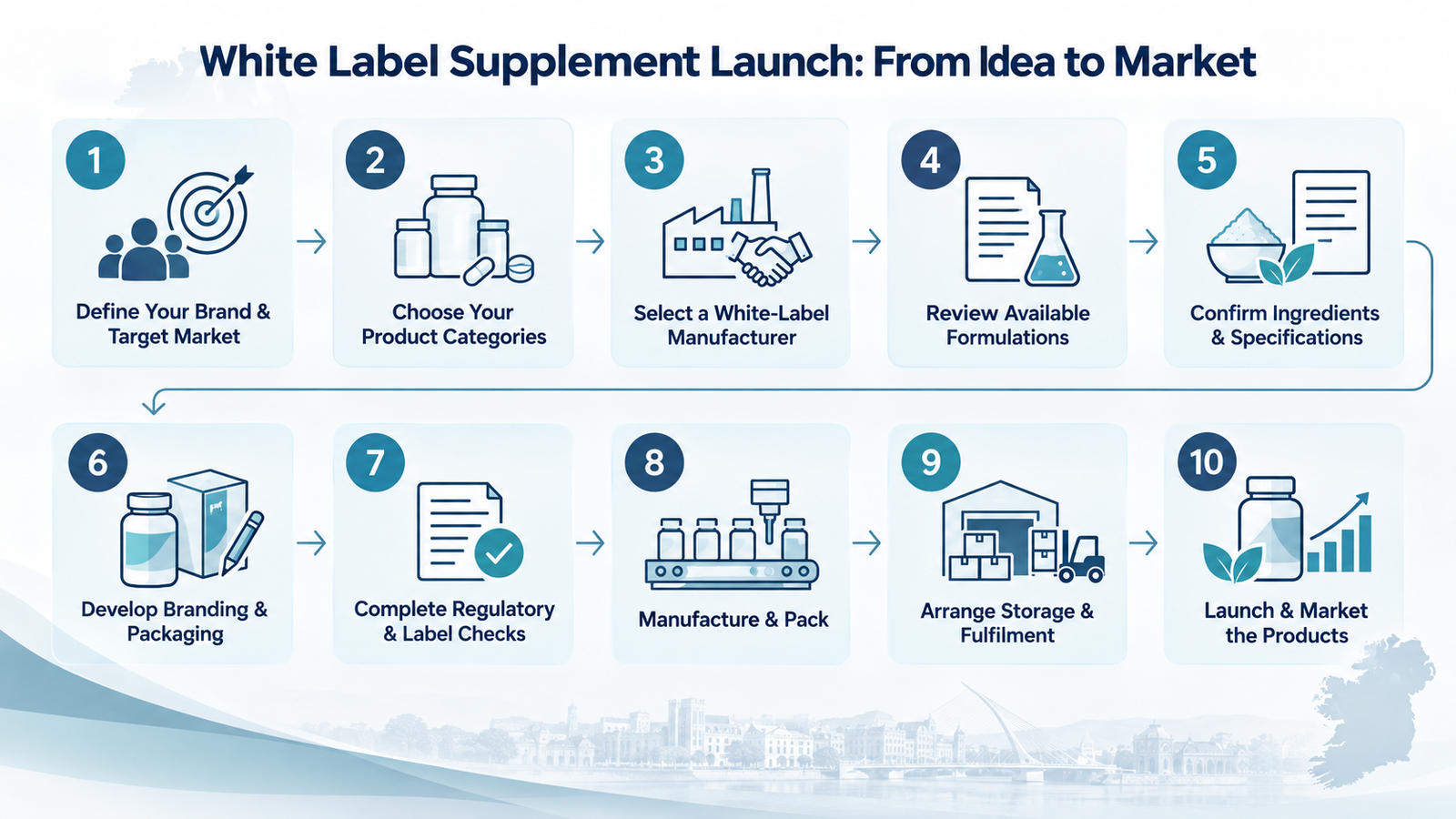
What’s a Simple Process for Launching a White Label Supplement Brand in Ireland?
- Define your brand and target market
- Choose your product categories
- Select a white-label manufacturer
- Review available formulations
- Confirm ingredients and specifications
- Develop branding and packaging
- Complete regulatory and label checks
- Manufacture and pack
- Arrange storage and fulfilment
- Launch and market the products
Final Thoughts
White labelling can offer a genuinely practical route into the supplement market, but a successful launch still depends on selecting the right products, the right manufacturer and a properly managed compliance process. Product selection, quality, branding, compliance, manufacturing and fulfillment all need to work together for a launch to succeed. It’s rarely just one of these that makes or breaks a new brand.
Bioreva Sciences combines ready and white-label formulations with approved GMP manufacturing partners, formulation support, filling and packing, regulatory support and storage and logistics helping brands move from an existing formulation to a shelf-ready product under one coordinated process.