

Choosing an ideal nutraceutical manufacturer includes more than finding a company which can efficiently produce capsules, tablets or powders for you. An ideal partner may help you with product concept, formulation, ingredient sourcing, manufacturing, testing, packaging, regulatory compliance, batch release, storage and delivery. Each of these services affects the finished product reaching your customer. Splitting these services across different providers is possible but it leads to communication gaps, fragmented documentation and supply-chain complexity that as a brand you need to take care of themselves. So the question that you should answer: what services as a brand you should look for while selecting an ideal nutraceutical manufacturer that to in a highly competitive market like Ireland and more importantly how to identify whether your prospective nutraceutical manufacturer is capable of providing these services that it is promising to handle your entire product life cycle rather than just one part of it?
What Does a Nutraceutical Manufacturer Do?
A third party nutraceutical manufacturer generally handles formulation, ingredient sourcing, manufacturing, quality control, testing, packaging, regulatory support, batch release, storage and logistics of your product. But not every supplier provides the same services, some only help you with the production of your product while some suppliers can handle your entire product life cycle.
The most important point when you compare nutraceutical manufacturers in a market like Ireland is whether your prospective supplier can efficiently fulfill your requirements and not just quoting you the lowest per unit price because a cheaper producer that leaves sourcing ingredients, arranging testing and managing compliance separately may cost considerably more in time and coordination than it saves per unit.
Why Do Nutraceutical Formulation Services Matter?
Formulation is where a product is genuinely shaped, so it’s worth understanding what support is available before production is even discussed. A capable partner may be able to develop a formulation from scratch, adapt an existing formula, recommend suitable ingredients, adjust dosage, change delivery format, carry out compatibility work and run stability studies to confirm shelf life.
Bioreva Sciences, for example, states that its formulation team can develop new products or adapt existing formulations, including ingredient sourcing, compatibility testing and stability studies. Strong nutraceutical formulation services matter because formulation decisions made early, ingredient forms, dosages, excipients, delivery format, shape everything downstream, from testing requirements through to what you can legally put on the label.
How Does Ingredient Sourcing and Supplier Management Work?
You should have the detailed information about where your prospective supplier is sourcing its ingredients. The points to talk about while getting the information are as follow:
- ingredient specifications,
- raw-material documentation,
- ingredient compatibility,
- alternative sourcing routes,
- traceability and supply continuity.
Directly managing sourcing simplifies procurement and reduces the need to coordinate multiple suppliers. It also ensures continuity: if a raw material becomes unavailable, a manufacturer with approved suppliers can quickly find a compliant alternative.
What Manufacturing Capabilities Should You Check?
Capability needs to match your actual product plans, not just general claims of experience. Worth confirming: tablets, hard capsules, soft capsules, vegan or HPMC capsules, powders, and sachets or pouches where available. Bioreva currently lists tablets, hard, soft and vegan capsules and powders among its manufacturing capabilities, alongside sachet and pouch packaging formats.
Beyond dosage form, ask about batch scale and process. Can the supplier handle pilot batches as well as full commercial production? What capacity is available? Which processes are manual versus automated? And can production scale as demand grows? A manufacturer well suited to a small launch run may need different equipment or lead times for a significantly larger batch later, so it’s worth understanding both ends of that range before committing to nutraceutical manufacturing Ireland-based production.
What Nutraceutical Quality Control Should Happen During Production?
This is where the distinction between a good supplier and an adequate one often becomes clearest. Relevant controls include in-process checks, weight checks, hardness testing, dissolution verification where applicable, batch documentation, traceability, manufacturing controls and finished-product checks. Bioreva states that its process includes in-process weight checks, hardness testing and dissolution verification.
The question worth asking any prospective nutraceutical manufacturer is specifically about what happens during production, not only afterwards. Robust nutraceutical quality control means problems are caught and corrected on the line, rather than discovered once an entire batch has already been produced and packed.
Which Nutraceutical Testing Services Should Be Available?
Testing requirements vary meaningfully by product, so it’s worth establishing what applies to yours rather than assuming a universal package. Depending on the product, relevant testing might include raw-material testing, finished-product testing, stability testing, microbiological testing and identity or purity testing. Not every test applies to every product, and a good supplier should be able to explain which are genuinely relevant to your formulation and which aren’t.
Bioreva refers to stability testing and testing through accredited laboratories as part of its regulatory workflow. When comparing nutraceutical testing services, it’s worth clarifying which tests are included in a quoted price and which are charged separately. This is a common source of unexpected cost later in a project. A supplier that can explain its testing rationale clearly is usually a better sign than one offering a long, undifferentiated list.
Should Packaging Be Part of the Manufacturing Workflow?
Packaging works considerably better when it’s built into the manufacturing workflow rather than handed to a separate supplier after production finishes. Capabilities worth checking include blister packaging, bottle and tub filling, sachet and stick-pack formats, pouches, carton packing, labelling and palletisation.
Bioreva’s site lists blistering, bottle, tub and sachet filling, label printing and application, carton packing and palletisation, with pouches and bulk boxes also referenced among its manufacturing formats. Well-integrated nutraceutical packaging services reduce the handoff delays that tend to appear when manufacturing finishes at one site and packaging begins somewhere else entirely which is precisely why it’s worth asking whether packaging is handled in-house or subcontracted out.
What Nutraceutical Regulatory Support Should a Manufacturer Provide?
Regulatory compliance can’t sensibly be separated from manufacturing, because formulation and labelling decisions directly determine whether a product can legally be sold. Areas worth discussing include FSAI notification, ingredient compliance, label review, health-claims review, batch-release support and any market-specific requirements if you plan to sell beyond Ireland.
Bioreva currently states that its regulatory workflow covers FSAI notification, EFSA health-claim review, ingredient compliance and QP batch release. Meaningful nutraceutical regulatory support means these considerations are built into the process from the start rather than addressed after formulation and artwork are already finalised which is the difference between a minor adjustment at proof stage and an expensive reformulation or reprint. A nutraceutical manufacturer Ireland brands can rely on should treat compliance as standard practice, not an optional add-on service.
How Should You Verify GMP, HACCP and Food-Safety Standards?
Certification matters, but the detail matters more than the logo. GMP reflects controlled, validated manufacturing processes; HACCP provides systematic food-safety hazard control; and FSSC 22000 offers a broader food-safety management framework.
Rather than accepting a general claim, ask specific questions: Which facility actually holds the certificate? Who issued it? What activities does its scope cover? Is it current? And does it apply to your specific product and process? Bioreva describes GMP, HACCP and FSSC 22000 certification within its Irish partner network as a useful starting credential, though as with any multi-site or partner model, it’s worth confirming which certified site and scope will actually apply to your order rather than assuming blanket coverage across every activity.
Private Label or White Label: Which Route Fits Your Brand?
These routes differ in how much of the product originates with you versus the manufacturer. Private labels typically start from a base formulation that can then be adapted to your requirements. White labels generally use an existing formula with minimal change. Contract manufacturing describes a broader production relationship built around agreed specifications, which may include either of the above or something fully bespoke.
Bioreva currently offers white label, private label and custom routes. Whether you’re evaluating a contract nutraceutical manufacturer Ireland-based or a private label nutraceutical manufacturer specifically, it’s worth clarifying exactly what level of adaptation is genuinely available, terminology varies between suppliers, and the same word can mean quite different things in practice.
Why Do Storage, Logistics and Fulfilment Matter After Packaging?
Things like finished products storage, temperature monitoring, stock management, pick-and-pack operations, shipment preparation, distributor delivery and direct to customer fulfillment still need coordinating and lag here can delay the launch of your product just as effectively as if there is some problem in your production.
Bioreva presents storage and logistics as part of its wider service proposition, including temperature-controlled and monitored storage and pick-and-pack fulfilment. A partner that can hold and dispatch finished stock removes a genuine operational burden for smaller brands without their own warehousing.
How Should You Evaluate Nutraceutical Manufacturing Services Before Signing a Contract?
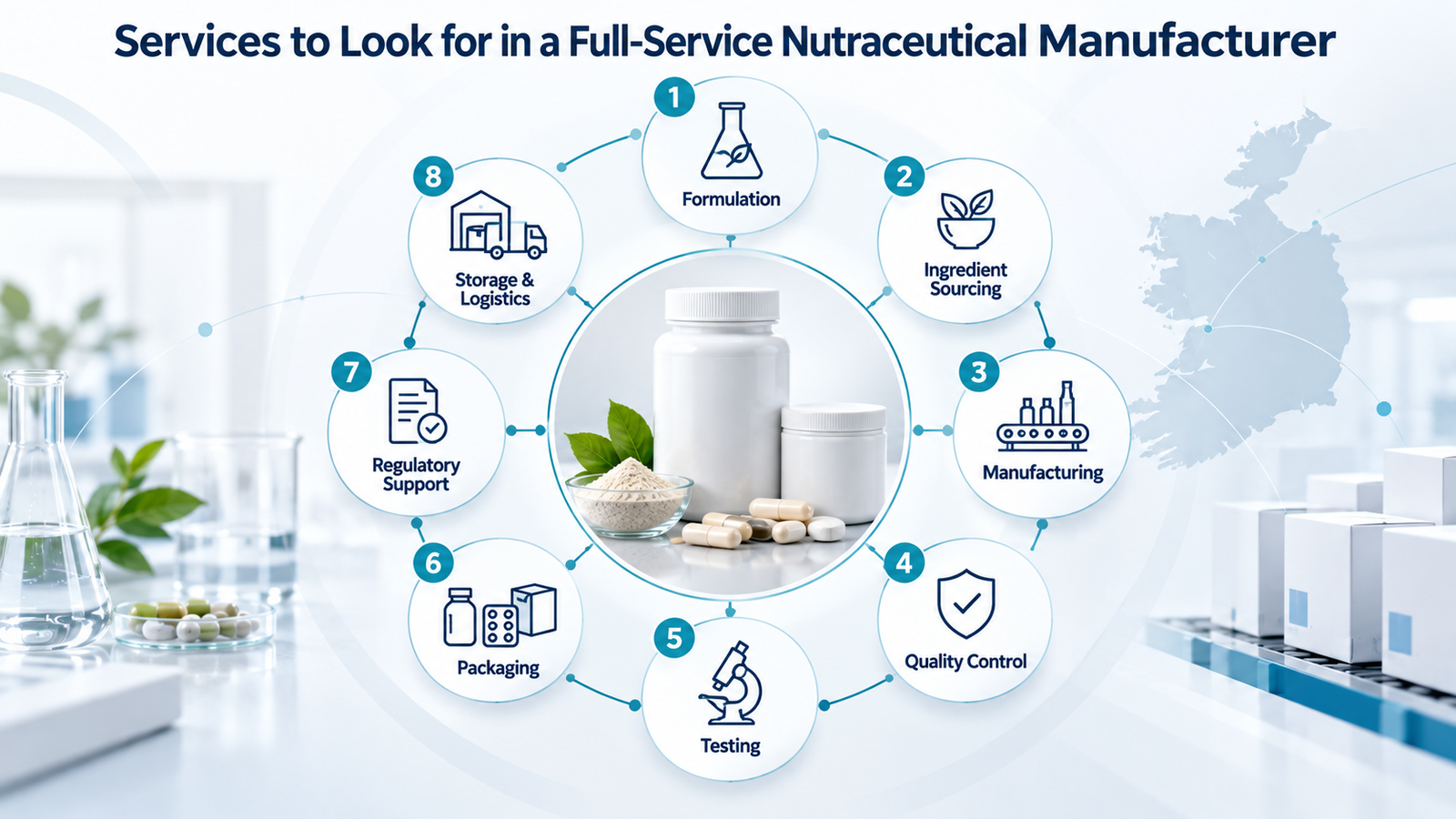
Use this as a practical checklist covering formulation, ingredients, manufacturing, quality, testing, packaging, regulatory, scalability and logistics. Specific questions worth putting to every supplier: Can you develop or adapt my formula? Do you source and qualify raw materials? Which dosage forms can you produce? Which tests are included, and which cost extra? Who manages FSAI requirements? And can you store and fulfill finished products?
Clear, specific answers here tell you far more about a nutraceutical manufacturer than any amount of marketing copy and vague responses at this stage rarely improve once a contract is signed.
What Makes an End-to-End Nutraceutical Manufacturer Better for Brands?
A production-only supplier will manufacture to your specification and stop there, leaving formulation, packing, regulatory work and warehousing to separate providers you coordinate yourself. An integrated partner connects formulation, manufacturing, packaging, regulatory support, storage and dispatch as one process.
The practical benefit is fewer handoffs, fewer documentation gaps and a single point of accountability when something needs resolving. Bioreva’s site explicitly positions its model around end-to-end nutraceutical solutions and one-partner coordination, a useful benchmark when comparing what “full service” actually means from one supplier to the next.
Final Thoughts
The right nutraceutical manufacturer should offer considerably more than production capacity. The strongest service package covers formulation, ingredient sourcing, manufacturing, quality control, testing, packaging, regulatory support and storage or logistics working together rather than as disconnected services a brand has to stitch together itself.
Bioreva Sciences combines formulation support, ingredient sourcing, manufacturing, stability testing, packaging, private label routes, regulatory support and storage and logistics under one coordinated model.
Looking for an end-to-end nutraceutical manufacturing partner in Ireland? Speak to Bioreva Sciences about your product requirements.