

Supplement packaging is part of a product’s quality and compliance chain, not simply a branding exercise. A packaging partner may be responsible for filling, blistering or bottling, labelling, secondary packing, inspection and finished-product handling each of which carries its own quality implications. For brands selling supplements in Ireland, a packaging partner should be evaluated on considerably more than price and pack appearance. That means understanding GMP, FSSC 22000 and HACCP food-safety certification, relevant quality-management systems, packaging-line controls and documentation. The key point running through all of it: the right certification depends entirely on what the company is actually doing for your specific product, not on which logos appear on their website.
Why Do Certifications Matter When Choosing Supplement Packaging?
Certification matters commercially because it points to consistent processes, product protection, traceability, hygiene and contamination controls, documented procedures, batch consistency, supplier confidence and general regulatory readiness. These are the things a brand can’t easily verify just by looking at a finished pack.
That said, certifications are evidence that a controlled system exists. They shouldn’t replace proper supplier due diligence. A genuinely good packaging partner should be able to explain exactly how their certified system applies to your actual product and packaging process, not just point to a certificate on a wall. Meeting recognised supplement packaging standards is a starting point for that conversation, not the end of it.
Why Is GMP Certification One of the First Credentials to Check?
Good Manufacturing Practice is defined as standardised controlled processes that make sure products are consistently manufactured and tested against defined quality requirements. For medicines the organisation is Health Products Regulatory Authority (HPRA) that sets the minimum standards of GMP that manufacturers and importers must meet, with compliance checked through routine inspection at regular intervals and issue a valid GMP certificate which is a prerequisite before products can be released in the market.
For supplement packaging, a GMP-controlled environment supports documented procedures, controlled operations, traceability and quality checks throughout the process even though food supplements sit under a different regulatory framework to medicines.The question that you should ask your prospective supplier:
- Which site actually holds the certificate?
- What activities are included in its scope?
- Is packaging and filling specifically covered, or only manufacturing?
- Is the certificate current?
- And can supporting documentation be provided on request?
For example Bioreva Sciences stated that its Longford Facility dietary manufacturing are approved for GMP, though it’s better if you confirmed the activities which are cover under the GMP certified supplement packaging.
Why Should You Look Beyond GMP to FSSC 22000 and HACCP?
GMP isn’t the only quality credential worth considering. FSSC 22000 (Food Safety System Certification) is a recognised food-safety management certification relevant to food and supplement supply chains. HACCP, meanwhile, is a systematic, preventive approach focused specifically on identifying and controlling food-safety hazards throughout production.
Bioreva states that its dietary supplement manufacturing sites are accredited for FSSC 22000, describing its manufacturing partners as GMP, HACCP and FSSC 22000 certified for dietary supplement supply. It’s worth understanding that these three credentials play distinct roles rather than treating them as interchangeable: GMP relates to manufacturing and quality practices, HACCP addresses food-safety hazard control specifically, and FSSC 22000 provides the broader food-safety management framework the other two typically sit within.
Does the Certification Actually Cover the Packaging Process?
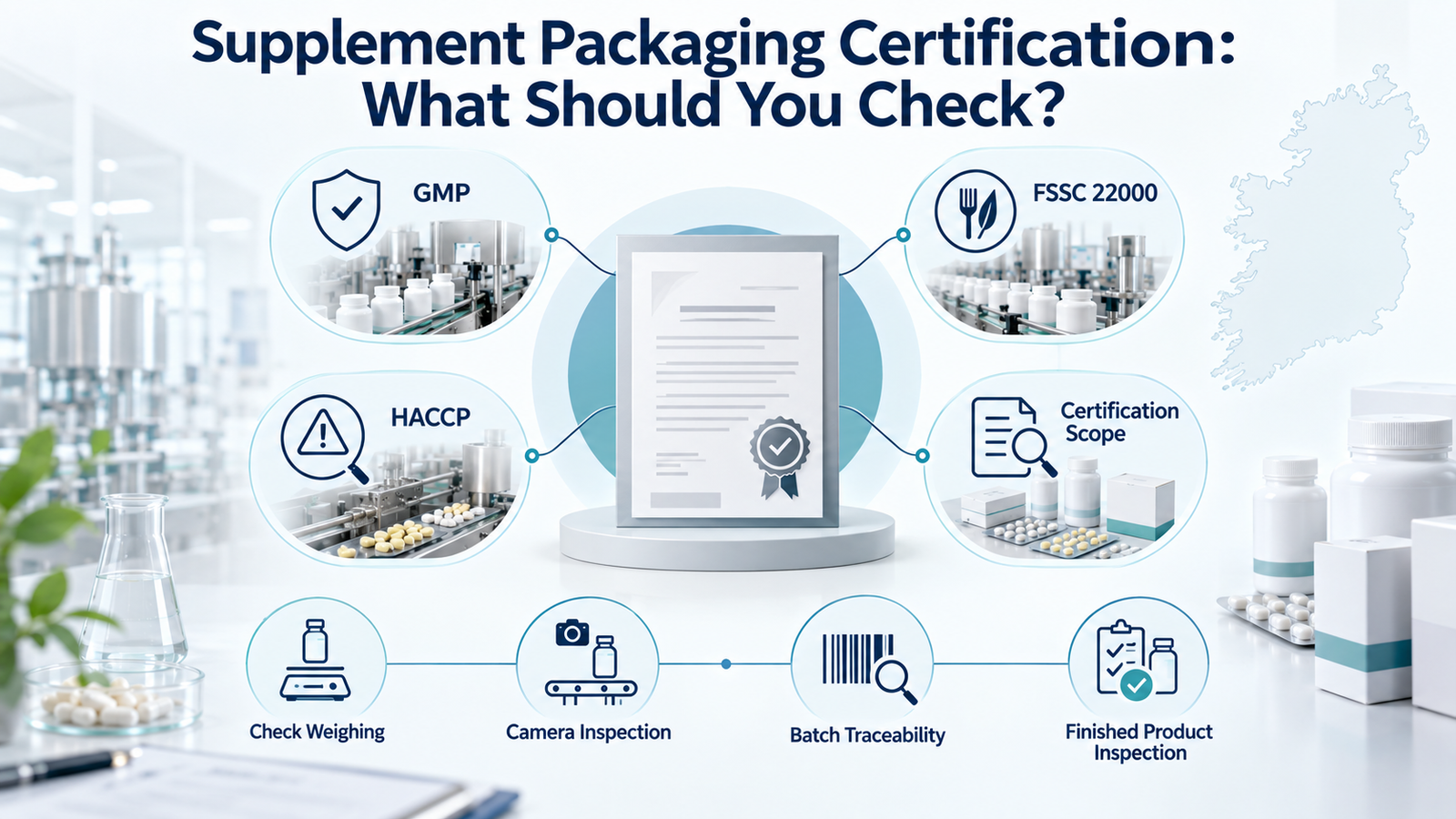
This is one of the most important and most commonly overlooked questions in the whole evaluation. A company may hold certified supplement manufacturing operations, but that doesn’t automatically mean every packaging activity, location or subcontractor is covered by the same certification.
Worth confirming directly: the certified legal entity, the physical site address, whether the specific packaging or filling activity is included, the certified product category, the exact scope of certification, its current validity, and whether any subcontracted activities fall inside or outside that scope. Many suppliers, including Bioreva, operate through a multi-site or partner manufacturing model, a perfectly normal and common approach, but one that makes it especially important to match the certificate to the actual service you’re purchasing, rather than assuming a company wide claim covers every site and activity involved.
What Supplement Packaging Quality Controls Should You Ask About?
Beyond certification logos, it’s worth understanding the operational controls a supplier actually applies day to day. Relevant areas include check weighing, camera inspection, line clearance, batch identification, traceability, packaging-material controls, finished-product inspection, documentation, reconciliation and rework procedures.
Bioreva’s filling and packing service, for instance, describes check weighing as part of bottle and tub filling, camera detection for blister packing, and product inspection with reworking and repacking capability. The distinction worth holding onto: a certification tells you a quality system exists in principle; these operational controls show you how that system is actually applied to your product on the packaging line and it’s the latter that determines real-world supplement packaging quality standards.
How Should Certifications Match the Type of Packaging You Need?
Evaluate a supplier’s credentials against the specific packaging format your product actually needs, rather than treating certification as a generic pass/fail check. For blister packaging, relevant considerations include individual-dose protection and suitability for tablets and capsules; Bioreva lists PVC/PVDC and cold-form Alu-Alu blister materials alongside manual and automated blister equipment with camera detection. For bottle or tub packaging, multi-dose suitability and the role of material, filling and check-weight controls matter most; Bioreva lists HDPE and PET formats here. For sachet or other flexible packaging formats, it’s worth confirming a supplier’s actual equipment, certification scope and product experience directly, since capability in this area varies considerably between suppliers.
Supplement Packaging Compliance: What Irish Regulations Should You Consider?
Compliance extends well beyond the packaging material itself. Food supplements marketed in Ireland for the first time must be notified to the Food Safety Authority of Ireland (FSAI); for products manufactured in Ireland, the manufacturer generally holds that notification responsibility.
On top of notification, supplement-specific labelling requirements apply covering things like the recommended daily portion, dosage warnings and the required “not a substitute for a varied diet” statement alongside general food-labelling requirements and nutrition or health-claims compliance under the applicable EU rules. In practical terms, this means brands should verify product name and category, ingredients, recommended daily portion, required warnings, nutrition information where applicable, responsible business operator information, storage conditions, claims wording and overall label legibility all before packaging goes into production, not after. This is the core of supplement packaging compliance, and it’s an area where a packaging partner with genuine regulatory experience can meaningfully reduce risk.
What About Pharmaceutical Packaging in Ireland?
Food supplements and medicines follow genuinely different regulatory pathways, so it’s worth treating this as a distinct category rather than an extension of supplement rules. For human medicines in Ireland, the HPRA regulates manufacturing activities including primary and secondary packaging, and manufacturers must hold the required manufacturing authorisation and comply with GMP as a condition of that authorisation. HPRA guidance on medicinal-product packaging also requires packaging information to align precisely with the authorised product information approved for that specific medicine.
The key takeaway for brands operating across both categories, or considering a move into pharmaceutical products: a pharmaceutical packaging Ireland project and a supplement packaging project should not be evaluated against exactly the same regulatory checklist, even where the physical packaging formats look similar on the surface.
How Do You Verify a Packaging Quality Certification?
This is worth making highly practical rather than taking claims at face value. Request the certificate name, the certifying body, the certificate number, the issue date, the expiry date, the certified site address and the precise scope of certification. Treat vague statements such as “we work to GMP standards” with caution that phrasing is not equivalent to being shown a current, valid packaging quality certification that actually covers the relevant site and activities.
Should You Choose a Packaging Company That Also Offers Manufacturing and Regulatory Support?
Packaging tends to become considerably more efficient when it’s integrated with formulation, manufacturing, packaging, regulatory support, storage and distribution, rather than managed as a series of separate, disconnected suppliers. Bioreva positions these as connected services on its website manufacturing, filling and packing, regulatory support, and storage and logistics working as one coordinated process. Whether or not Bioreva is the right fit for a given brand, this integrated model is generally worth looking for: it reduces the communication gaps and delays that tend to appear at the handoff points between separate suppliers.
A Checklist for Evaluating Supplement Packaging Companies in Ireland
Use this as a quick reference when comparing suppliers:
- Does the site hold current GMP certification covering the relevant activities?
- Is FSSC 22000 or HACCP accreditation in place for food-safety management?
- What packaging formats and materials can they actually support?
- What operational quality controls run on the packaging line?
- How is Irish regulatory compliance notification, labelling, claims handled?
- What documentation is available on request?
- Can they scale with your business, and can packaging be coordinated with wider supply-chain support?
Final Thoughts
Don’t choose a supplement packaging partner based on a certification logo alone. A strong supplier should be able to demonstrate relevant certification, the correct scope for your specific product, suitable equipment, documented quality controls, genuine regulatory understanding, traceability and room to scale.
Bioreva Sciences combines certified manufacturing with filling and packing, regulatory support and storage and logistics as one integrated service for the supplement sector. Speak to Bioreva Sciences about your supplement packaging and compliance requirements.