

Partnership with a dietary supplement contract manufacturer involves more than the production of your brand in their facility. An ideal partner will offer you help with formulation, ingredient sourcing, quality testing, regulatory compliance, and packaging. Knowing the services your partner offers before signing the deal will help you avoid costly surprises later. This article will help you realise what you should realistically expect when working with a contract manufacturer in Ireland.
What Does a Dietary Supplement Contract Manufacturer Actually Do?
In practical terms, the relationship can include understanding the product briefly, reviewing or developing formulations, selecting ingredients, considering dosage and format, testing and stability work, supporting compliance and claims, manufacturing, packaging and product release. Not every manufacturer offers the same depth of product-development support. Some focus narrowly on production to a supplied specification, while others work as a genuine formulation-led partner from concept onwards.
This distinction matters more than it might first appear. A contract supplement manufacturer Ireland brands choose purely on production price may leave formulation, testing and compliance entirely in the brand’s hands work that a more capable dietary supplement contract manufacturer Ireland-based businesses could instead absorb as part of one coordinated service.
Why Expect a Clear Product Brief Before Formulation Begins?
A professional formulation process should establish the fundamentals at the outset: target audience, product category, intended benefits and positioning, desired ingredients, dosage form, serving size, product differentiation, target market and any commercial constraints. Skipping this step tends to surface as confusion later for any dietary supplement contract manufacturer relationship, a format chosen too early, or an ingredient list assembled before the audience was properly defined.
A capable manufacturer will typically organise formulation capability around distinct product categories, since different categories tend to carry different common activities, dosing conventions and audience expectations. Establishing which category your product genuinely belongs to, and being specific about the brief from the start, gives the rest of the project a considerably firmer foundation.
Why Expect Category-Specific Formulation Expertise?
This is where genuine expertise becomes visible. Formulations built for health and everyday wellbeing, beauty, general nutrition, sports performance, and men’s or women’s wellness may each require different activities, dosing conventions, target users and claim considerations. A sports-nutrition audience checking a creatine dose has very different expectations to someone choosing a prenatal multivitamin, even where the physical dosage form looks similar.
The value of category expertise isn’t a product catalogue to browse, it’s a dietary supplement contract manufacturer that understands why a given category behaves the way it does, and can explain those conventions specifically rather than generically. That’s usually the clearest early signal of whether a supplier genuinely understands supplement product development Ireland brands need, or is simply producing to whatever specification is handed over.
What Support Should You Expect With Ingredient Selection and Formula Development?
Formulation involves considerably more than listing popular ingredients. A genuine formulation partner should help consider ingredient suitability, active combinations, dosage levels, ingredient interactions, delivery format, positioning, sourcing and manufacturability together. It’s also worth understanding the practical difference between using an existing formula largely unchanged, adapting one, and developing something newly formulated from scratch each carries different timelines, costs and outcomes.
A strong dietary supplement contract manufacturer should be able to explain these trade-offs plainly, and flag early where a requested ingredient combination might create formulation or stability challenges, rather than only raising it once development is well underway.
Why Expect Formulation Testing and Stability Considerations?
A formula that looks good on paper still needs to hold up in practice. Relevant considerations include compatibility testing, stability studies, dosage-form suitability, product consistency and shelf-life performance. A formulation needs to be genuinely practical to manufacture, stable across its intended shelf life, and suitable for the format it’s been designed around three things that don’t automatically follow from a promising ingredient list alone.
This is a step worth asking about directly with any prospective dietary supplement contract manufacturer: how is stability actually assessed, and at what point in development does that testing happen? A manufacturer that builds this in early, rather than treating it as a final check, tends to avoid costly reformulation later.
Why Expect Claims and Regulatory Considerations to Be Part of Formulation?
Formulation and compliance are genuinely connected, not separate stages. Permitted health claims differ by ingredient and by audience, which means product composition decisions made early directly affect what can legally be claimed on the finished label later. Considering presentation and intended market at the formulation stage rather than treating regulatory review as a final compliance check is what separates careful dietary supplement manufacturing Ireland practice from a rushed, retrofitted approach.
Getting this sequence right (ingredient choice, then permitted claim, then label wording) avoids the far more expensive scenario of discovering at the artwork stage that your intended marketing message simply isn’t available for that ingredient or category.
What Should a Clear Route From Formulation to Manufacturing Look Like?
Once formulation is genuinely settled, the handover into production should follow a defined path:
- approved formulation,
- ingredient specifications,
- production requirements,
- manufacturing,
- quality checks.
It’s worth confirming, specifically, whether the formula is properly documented, whether ingredient specifications are established, whether the dosage format is confirmed, whether production requirements are understood, and whose responsibility final approval actually sits with.
A vague or informal handover at this stage is a common source of delay not because the formulation itself was wrong, but because nobody confirmed with the dietary supplement contract manufacturer that it was genuinely production-ready before manufacturing began.
Why Expect Manufacturing Capability to Match the Formulation?
Formulation decisions and manufacturing capability need to work together, not be assessed in isolation. Common formats include tablets, capsules, vegan capsules and powders, and it’s worth confirming directly whether a manufacturer can actually produce your specific format, at your required batch size, in the dosage configuration your formulation calls for.
A formula that performs well at small trial scale doesn’t automatically translate to reliable, reproducible commercial batches which is exactly why supplement manufacturing services Ireland brands rely on should be assessed on their ability to scale a specific formulation, not just on general production experience.
What Quality Systems and Manufacturing Controls Should You Expect?
Quality systems, food-safety controls, ingredient traceability, batch documentation, in-process checks and finished-product controls should all sit behind the finished product, ensuring consistency from one batch to the next. The more useful question isn’t simply whether a manufacturer holds relevant certifications, but how those systems actually apply to the specific product you’re having made.
Keep this proportionate to the project, a brief confirmation from your dietary supplement contract manufacturer of what’s in place and how it’s documented is usually sufficient at this stage, rather than an exhaustive audit of every certification a supplier holds.
Why Should Packaging Fit the Product and Brand?
Packaging decisions should follow from the formulation and dosage form, not be chosen independently. Depending on the product, that might mean bottles, blisters, sachets or stick packs, pouches, or another applicable format. The priority here is fit protection, usability and regulatory presentation suited to the specific product rather than defaulting to whatever packaging format happens to be quickest to source.
Why Expect Flexibility From a Manufacturing Partner?
As a brand you might contact manufacturing partners for different requirements for different products. For some products you have a complete formula ready and just need help with production, for some products you might just have a concept and require help with everything else and for some product you might have an existing formulation that requires little bit adaptation before it can be launched in the market. Therefore your manufacturing partner should be flexible enough to help you with all kinds of requirements.
What Should You Ask Before Choosing a Contract Supplement Manufacturer?
A practical checklist worth working through covers five areas.
- Formulation: can they develop or adapt formulations, and support compatibility and stability work?
- Manufacturing: which dosage forms and batch sizes can they actually produce?
- Quality: what systems and records apply, and how are they documented?
- Regulatory: who supports claims and compliance work, and at what stage?
- Commercial: what’s the minimum order quantity, typical lead time and overall service scope?
Specific, confident answers across all five areas tell you far more about a genuine nutraceutical contract manufacturing Ireland partner than general reassurance ever will. Vague responses here are usually a preview of how the rest of the relationship will go.
What Does a Typical Supplement Development Journey Look Like?
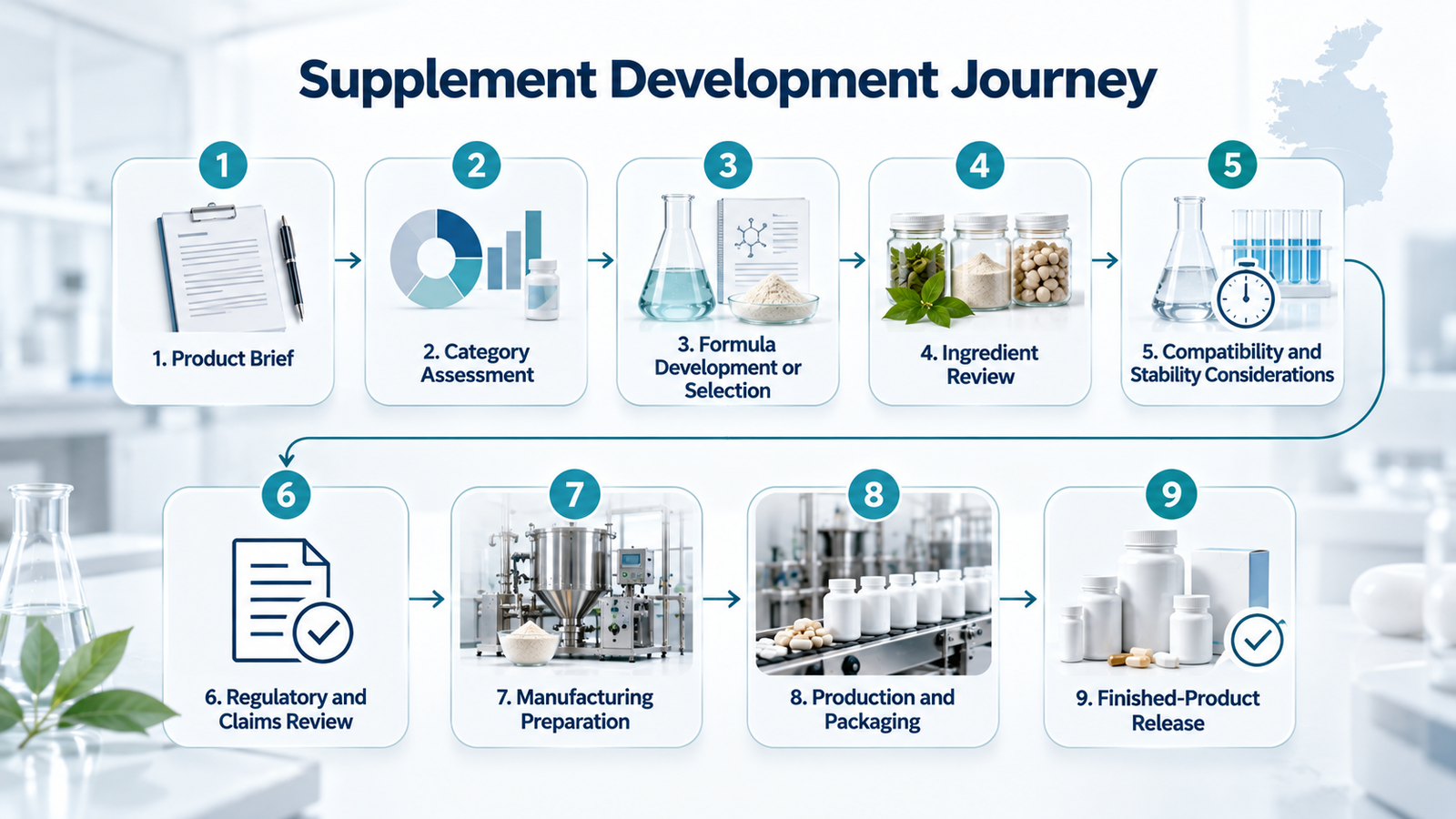
The following steps are involved in supplement development journey:
- product brief
- category assessment
- formula development or selection
- ingredient review
- compatibility and stability considerations
- regulatory and claims review
- manufacturing preparation
- production
- packaging
- finished-product release.
Each stage informs the next, which is why a manufacturer that treats them as genuinely connected rather than as separate handoffs between different teams tends to deliver a smoother, faster path to a market-ready product.
Conclusion
A strong manufacturing relationship should provide genuine clarity across formulation, ingredient selection, testing, compliance, manufacturing and packaging not just a quote for production. Good manufacturing starts with a well-defined and appropriately developed product, which means understanding what happens before production matters just as much as what happens on the factory floor.
For brands exploring formulation-led supplement development in Ireland, Bioreva Sciences provides a formulation-focused route covering multiple wellness categories and different product formats.